RSS
Hello! Welcome to the Great Movies Database.

Today news: The Best, Worst and Wildest Moments of the 2021 Emmy Awards


The 73rd Primetime Emmy Awards were live, in-person and as gloriously awkward and frustratingly imperfect as ever. Host Cedric the Entertainer opened the show with a montage of some favorite TV moments from the last year. Then Cedric, Lil Dicky, LL Cool J and Rita Wilson rap-sang a TV-themed version of the late Biz Markie’s “Just A Friend” while Billy Porter, Tracee Ellis-Ross, Mandy Moore, the cast of Hamilton, Allison Janney, Ken Jeong and Michael Douglas clapped along. It was the perfect reminder that despite being well into our second pandemic year, the Emmys are back in all their ridiculous, celebrity-fueled televised glory.
[time-brightcove not-tgx=”true”]

Here are some of the best, worst and wildest moments of the 2021 Emmy Awards.

Most Awkward Moment

While presenting the very first award of the evening, Seth Rogen was clearly nervous about the show’s COVID-19 protocols. “There are way too many of us in this little room,” he said, noting that it was supposed to be outdoors, but instead was in a “hermetically-sealed room” that he clearly wasn’t enjoying. He cracked, “It’s more important that we have three chandeliers than that we make sure we don’t kill Eugene Levy tonight.”

Best Verisimilitude

When Hannah Waddingham won for her role as team owner Rebecca Welton in Ted Lasso, Juno Temple, who plays her onscreen best friend Keeley Smith, went over the top celebrating her win, even though they were competing against each other. It was like a bonus scene from a future episode of Ted Lasso.

Read More: Ted Lasso and TV’s Strange Quest to Build a Perfect Man

Worst Verisimilitude

Ken Jeong presented the award to Saturday Night Live outside of the venue after getting fake locked out for not having the proper COVID paperwork and the security guard finding a bottle of Ivermectin from a “Joe Rogan swag bag.”

Biggest Eye Roll

When the entire Supporting Actor in a Comedy category was made up of the cast of Ted Lasso. There were other shows with other stars, right? (Hello, Bowen Yang and Carl Clemons-Hopkins, whose red-carpet look, by the way, deserved to win its own category.)

Most Method Actor

When real human Brett Goldstein accepted the award for Best Supporting Actor for his work in Ted Lasso, he swore so much that a huge chunk of his speech was bleeped. Did he accept the award as his foulmouthed character Roy Kent or has he actually just become Roy Kent?
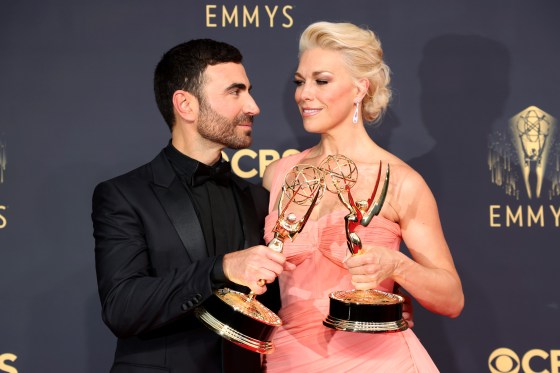
73rd Primetime Emmy Awards - Press Room
Getty Images—2021 Getty ImagesBrett Goldstein and Hannah Waddingham, two of the night’s ‘Ted Lasso’winners

Best Supporting Actress in an Awards Speech

Kate Winslet got a threepeat in this category. Julianne Nicholson gave a heartfelt nod to her Mare of Easttown co-star in her acceptance speech. That was seconded by WandaVision’s Evan Peters, who screamed his thanks to “Kate Winslet for being Kate Winslet!” Mindy Kaling rounded things out by joking that Winslet wasn’t British and everyone knows her Mare of Easttown accent was her real one.

Best Non-British Actor Playing British

Gillian Anderson beamed in from London to accept her award for her portrayal of Margaret Thatcher on The Crown. May we all be inspired to have the confidence of an American auditioning to play one of the most famous prime ministers on a British show—and then win an Emmy for it.

Read More: Why Is Margaret Thatcher Always Crying in The Crown?

Biggest Missed Opportunity

Tobias Menzies wasn’t on-hand to accept his award for The Crown, which made it feel even more frustrating that the late Michael K. Williams didn’t win for Lovecraft Country.

Most Self-Aware Moment

While John Oliver was accepting the award for Last Week Tonight he noted, “I think like many of us in the room I was rooting for Conan, so this is bittersweet. Thank you, Conan, for 30 years of inspiring comedy writers.” O’Brien ended his three-decade run as a late-night host in June.

Most On-Brand Bit

After the cast of Schitt’s Creek walked out to a standing ovation, Dan Levy noticed a problem: “There’s nothing on the prompter.” Soon Eugene Levy admitted that he had started a small war with the show’s writers and the result was a charmingly ridiculous bit that felt like a little extra time with the Rose Family.

Read More: Catherine O’Hara Finds Humor in the Gulf Between Perception and Reality

Least Timely Bit

Remember [what felt like] 40 years ago when a fly landed on the head of then-Vice President Mike Pence during a debate with Kamala Harris? The writers at the Emmys did and wrote a whole sketch that ended with the fly yelling, “All flies matter!”

Best Advice

When Quantum Leap’s Scott Bakula, The New Girl’s Zooey Deschanel, Seinfeld’s Jason Alexander, How I Met Your Mother’s Alyson Hannigan, and The Wonder Years’ Fred Savage bemoaned their lack of Emmys, Cedric brought out Dr. Phil. He had some sage advice for the stars: Get yourself booked on Ted Lasso or The Crown!

Worst Use of Play-Off Music

Jean Smart had a lot to talk about, including thanking her co-stars and writers on both Hacks (for which she won Best Lead Actress in a Comedy Series) and Mare of Easttown (for which she was also nominated), congratulating the newlywed head writers on Hacks, thanking her support system, and noting the recent loss of her longtime husband Richard Gilliland. But that didn’t stop the producers from trying to play off a legend.

Best Jennifer Coolidge
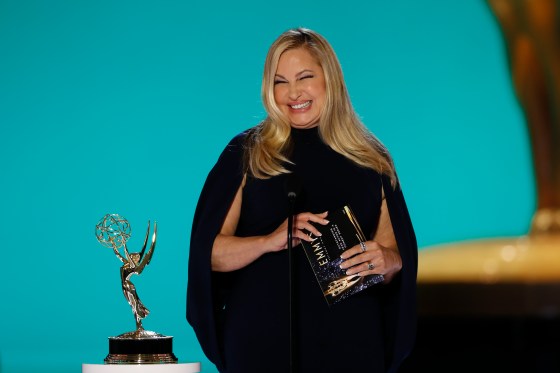
The 73rd Emmy Awards
CBS via Getty Images—2021 CBS Photo ArchiveJennifer Coolidge presents at the 2021 Emmys

The White Lotus standout gave her most Jennifer Coolidge performance while presenting the award for Lead Actor in a Comedy Series. It was so good that if you could give Emmys for Emmy presentations, Jennifer Coolidge would win. (Many on Twitter pointed out that she’d better be back onstage a year from now, minus the presenter’s envelope and plus a statuette for her work on Mike White’s summer hit on HBO.)

Read More: The White Lotus Is the Must-See Show of the Summer

Best Way to Stick it To Your Former Boss

In his acceptance speech, Ted Lasso’s Jason Sudeikis noted that his former Saturday Night Live boss Lorne Michaels had slipped out to go take “a dump.” Hopefully Michaels has a sense of humor?

Best Way to Stick to Your Sorta Boss

When the head honcho of the Television Academy took the stage, a ruckus arose and the audience could be heard loudly cracking up. When the cameras finally cut to the cause of the commotion, it turned out to be Conan, loudly and proudly saluting the man and not stopping until all eyes were on him. As Wanda Sykes tweeted, “Conan is giving no F’s tonight!”

Best Time Management

When Debbie Allen took the stage to accept the Governor’s Award, the producers gave her a countdown clock. She was having none of it. “Turn that clock off, I ain’t paying no attention to it,” said the multi-hyphenate star of Fame, A Different World and Gray’s Anatomy. “Turn it off! Turn it off!” She got out her entire speech but deserved so much more, particularly in light of what happened next…

Worst Time Management

When Scott Frank was delivering his acceptance speech for Outstanding Directing for a Limited or Anthology Series or Movie, for The Queen’s Gambit, the orchestra attempted to play him off three times. He ignored them, told them to knock it off, and talked right through it as if he were entitled to more time on stage than anyone else, including Debbie Allen. It was one of the most lambasted moments of the evening on social media.

Most Real Reaction

The 73rd Emmy Awards
CBS via Getty Images—2021 CBS Photo ArchiveMichaela Coel wins an Emmy for ‘I May Destroy You’

When Michaela Coel finally won an award for the brilliant I May Destroy You, she nearly collapsed at her table in shock and excitement, which is exactly what most of us would do. It’s worth noting that her acceptance speech was pure poetry that should be printed out and handed to writers everywhere. (Read it here.)

Most Worthwhile Aside

Onstage presenting yet another award to the decorated Mare of Easttown, Beanie Feldstein noted that she is “so proud of what women are achieving” in Hollywood and Sarah Paulson added, “…And for only 70 cents on the dollar!” Lest we forget the pay gender gap that continues to plague far more than just Hollywood.

Worst Bleep

When Olivia Colman won for The Crown she said something apparently potty-mouthed while cheering on Michaela Coel, but thanks to bleeping we may never know what she said. (Though one Australian reporter user tweeted what Colman allegedly said, thanks to an apparently bleep-less Australian broadcast.)

Most Honest Speech

While collecting the award for his Election Night special, Stephen Colbert gave his most heartfelt gratitude to Ted Lasso and Last Week Tonight “for not being in this category.” In the related sub-category of Best Staff Addition, when Colbert’s staff came on stage to collect their award, Conan decided to walk up and join them.

Worst Repeat Performance

While the Ted Lasso theme song is fine enough when it plays at the opening of each episode, hearing the first five seconds over and over and over again with every award they won started to have the effect of sounding like Marcus Mumford was screaming directly into the camera.

Worst Possible Repeat Performance

When The Queen’s Gambit was announced as the winner for best drama series, Twitter collectively groaned, oh no, not that guy again. Luckily Scott Frank wasn’t able to repeat his performance as he wasn’t given the mic.

Most Frustrating Reality

The award show presentation on the whole was undeniably and refreshingly diverse, but what does that matter when so few winners were?

Today news: Pour One Out For the Network Comedy


The problem with TV these days, as everyone knows, is that there’s too much of it. By the time you clear out last month’s backlog of binges, another truckload of content has piled up at your doorstep. Streaming services and to a lesser extent traditional networks will maintain that wearying momentum throughout the fall, with a huge variety of new and old programming.

[time-brightcove not-tgx=”true”]

In September alone, HBO rebooted Ingmar Bergman’s Scenes From a Marriage; Showtime countered with a crime drama, American Rust, that sounds like Jeff Daniels of Easttown (but unfortunately isn’t); Apple unveils an elaborate Isaac Asimov adaptation, Foundation; and PBS has Ken BurnsMuhammad Ali. FX has frontloaded B.J. Novak’s provocative anthology The Premise, an ambitious reconsideration of cult comic-book series Y: The Last Man and a long-awaited season of American Crime Story that takes on the impeachment of Bill Clinton. Also this fall, Disney+ continues its run of Marvel and Star Wars spinoffs. Many buzzy series—including HBO’s delightfully excruciating Murdochian satire Succession—are due back after lengthy COVID-related hiatuses. America’s favorite fictional serial killer Dexter is, for reasons known only to the network execs who greenlighted his comeback, on the prowl again.

This abundance of shiny new shows makes it easy to overlook what’s missing from the upcoming season’s primetime schedule—namely, NBC’s venerable Thursday-night comedy block. Anchored in the 1980s by Cheers and The Cosby Show, then Friends, Seinfeld and Frasier in the ’90s, the lineup more than earned its “Must See TV” branding throughout the late 20th century. Even as appointment viewing waned in subsequent decades, it remained an oasis for smart, imaginative sitcoms: The Office, 30 Rock, Parks and Recreation, Community and, in a last gasp of greatness, The Good Place and Superstore. That legacy has ended, as the network just last night aired the series finale of long-running cop sitcom Brooklyn Nine-Nine. Come October, NBC will devote Thursday nights to Law & Order spinoffs, driving scripted comedy off the primetime schedule entirely.

Other Big 5 broadcasters seem to be losing faith in comedy series as well. The CW belongs to superheroes, Archie Comics and B-grade nonfiction programming now. While Fox’s Sunday adult-animation block is still going strong, there isn’t a single live-action sitcom on its fall schedule. ABC has carved out Wednesdays for family comedies, but the only “new” title is a Wonder Years reboot. CBS seems like a relative haven for the genre, until you realize that one mega-producer, The Big Bang Theory bard Chuck Lorre, has a hand in four out of its six fall sitcoms. Among the Emmy nominees for Outstanding Comedy Series, only one—ABC’s black-ish, whose eighth and final season is expected to premiere in 2022—hails from a broadcast network.

Scripted comedy isn’t going anywhere. Cable channels and streaming services are bursting with great examples, as multimedia conglomerates like NBCUniversal shift new projects from creators with cult followings (Mike Schur’s Rutherford Falls, Tina Fey’s Girls5eva), to platforms such as Peacock, where they might pay for themselves in subscription dollars. But watching Hacks or Ted Lasso or Never Have I Ever at your own pace isn’t the same experience as ducking into Cheers or Central Perk every Thursday evening and reliving the highlights of each episode at the watercooler Friday morning with people you knew had tuned in last night.

I’ve been frustrated for a while by a growing sense that free, linear TV is devolving into nothing more than a way of filling time between commercials or, worse, an endless advertisement for the streaming subscription service operated by each broadcaster’s corporate parent. But beyond that, there’s something depressing about having to bid farewell to the precise kind of network comedy we’ve lost. Since the Cheers era, most of NBC’s best and most beloved sitcoms have centered on groups of unrelated adults—people who share a workplace or hangout, community college students or dead souls damned to a hell designed by a demon with the avuncular charm of Ted Danson.

Unlike most family comedies, which date back to the dawn of television and now predominate among the last surviving network sitcoms, with their interchangeable living-room sets and preordained generational hierarchies, the typical Must-See TV show threw together characters from all walks of life. Superstore put a white business-school dropout (Ben Feldman) to work at a big-box store under the supervision of a Honduran-American mom (America Ferrera) who chose supporting her young family over college; the larger cast of characters represents a broad range of racial, sexual, class and religious identities, as well as disability and immigration statuses. A similarly diverse cohort of fresh-faced high school grads, stay-at-home moms, oddballs and con artists in need of mid-career credentials form a study group in Community.

Though their chief purpose was to make us laugh, these sitcoms were premised on the idea that people from very different backgrounds, with very different beliefs, could get along. Even the most homogenous among them thrived on friendly banter between adults with divergent, sometimes ill-informed worldviews; think paleontologist Ross arguing evolution with space cadet Phoebe on Friends. These shows’ vast, often demographically diverse audiences all found something to chuckle about—because they didn’t take themselves or each other too seriously.

The network comedy is, from a business perspective, a casualty of the streaming revolution. But its death is also emblematic of a culture that has become so politically, socially and generationally fragmented, with heightened sensitivities on all sides, that large swathes of the American public can’t even agree on what’s funny anymore. With that in mind, as we feast on all that pay-TV has to offer, let’s also pour one out for the kind of show that got tens of millions of us to gather in our living rooms at the same time each week, to laugh at the same jokes.

Today news: The Eyes of Tammy Faye Turns the Fallen Televangelist into Camp Curiosity


In the grand scheme of Christian forgiveness, maybe it’s a nice idea to try to reclaim the honor, or at least the humanity, of the late evangelist TV personality Tammy Faye Bakker, one-half of the 1980s prayer-and-praise power couple Jim and Tammy Bakker. That’s the goal, apparently, of Michael Showalter’s cartoonishly sincere biopic The Eyes of Tammy Faye, in which Jessica Chastain plays the chirpy entertaingelist as a sympathetic country sweet-pea, largely a victim of her husband’s ambition and an only semi-willing accomplice in the greed and corruption that eventually brought the couple to ruin—and also robbed countless regular working people of their hard-earned money.
[time-brightcove not-tgx=”true”]

In the 1980s, Tammy Faye and Jim Bakker, husband-and-wife chipmunks united in the service of the Lord, ruled the Christian-television airwaves with their cheesy but unapologetically celebratory show, designed to fund their ever-growing PTL Club operation. Folksy, apple-faced Jim spread the word of God like margarine, greasing the wheels to entice the folks at home to call in with their donations. Tammy Faye, with her helium speaking voice and peppy gospel-tune belting—not to mention her clown-on-the-town makeup, which became more garish and extreme as the duo became richer—was lively and sugary and fun to mock. Of all the ’80s TV evangelists—among them Pat Robertson and Moral Majority leader Jerry Falwell, both of whom played roles in the Bakkers’ rise and fall—Jim and Tammy Faye seemed the most benign, if you could apply that word to any peddler of rigid religious ideologies who’s also in love with the almighty dollar.

These two certainly seem harmless at the start of The Eyes of Tammy Faye. The movie follows the Bakkers’ pious trail from their meet-cute in Bible college, through the early years of their marriage, in which they took to the road as traveling preachers, to their first taste of success, as the hosts of a TV show that used puppets to teach kids about God’s love. Andrew Garfield plays Jim Bakker as an aw-shucks charmer who’s honest about his moneymaking goals: he’s convinced the Lord doesn’t want him to be poor, though it turns out that Tammy Faye is the one who comes up with the puppet idea, a hint that everything they built might have begun with her.

Chastain plays Tammy Faye with a feral eagerness that’s poignant until it turns grating. In the movie’s early scenes, she’s a saucy seductress, a good girl who wants to have fun—within the bounds of holy matrimony, of course. Her eyes are wide and unblinking, like a doll’s; her skin is brushed with porcelain innocence. This is a far cry from the older Tammy Faye we see in the movie’s preamble, who reveals to an unseen makeup artist that her harsh eyebrows and lipliner are tattooed on, and her black-dagger eyelash fringe is non-negotiable: It’s her trademark, she insists, and people wouldn’t know her without it.

But even though Chastain has clearly studied Tammy Faye’s mannerisms and vocal tics and runs through them admirably, the movie’s candy-colored varnish seems to have waterproofed it against anything so messy as real feeling—or judicious assessment. Tammy Faye suffers all manner of hardships and rejections: Jim loses interest in her sexually and engages in dalliances with both men and women (though the movie is cryptically unspecific about the former, perhaps for legal reasons). He becomes consumed with making money for his expanding empire—Garfield plays the older, graying version of Jim as a half conniving, half distracted striver. Meanwhile, the increasingly miserable Tammy Faye succumbs to an almost-affair with Nashville record producer Gary Paxton (Mark Wystrach), gets hooked on Ativan and is eventually coerced into making a tearful confession of her sins on television.

Read more reviews by Stephanie Zacharek

This is potentially moving dramatic stuff—or at least bracing melodramatic stuff—but Showalter’s dramatization has a glazed, glassy-eyed surface, like a Pee-wee Herman movie without any of Paul Rubens’ surreptitiously sophisticated kindergarten wit. The Eyes of Tammy Faye was adapted by writer Abe Sylvia from Fenton Bailey and Randy Barbato’s 2000 documentary of the same name, which was anchored by interviews with the fallen Tammy Faye that painted her as a rather sweet, remorseful soul. (She died in 2007.) And to the degree that fairness matters, Showalter (director of 2017’s The Big Sick) is fair to Tammy Faye, dramatizing her heartfelt 1985 interview with pastor and AIDS patient Steve Pieters (played by Randy Havens)—significant because in doing so, she not only courted the wrath of Falwell, an increasingly powerful conservative evangelist bully (played, with creepy accuracy, by Vincent D’Onofrio), but also risked alienating millions of hardcore Bible thumpers who sincerely believed AIDS was God’s way of wiping homosexuals off the face of His earth.

But mostly, Showalter’s movie wavers between parody and pathos, never certain where it wants to land. And no matter what you think about the real Tammy Faye—and no matter how much pity you might feel for her after the Bakkers’ kingdom crashed around her—she was still culpable in bilking PTL Club “partners,” as donors were called, out of millions. (The movie shows her buying multiple fur coats, for herself and for others. She never asks where the money is coming from.) What’s more, she was also a complicit cog in the politically ambitious Evangelical machine of the 1980s, whose influence over American government spreads its ugly shadow to this day. A great movie can make you feel empathy for a seemingly unredeemable character. But The Eyes of Tammy Faye succeeds only in presenting its subject as a camp curiosity, a one-woman pep rally for the Lord in linebacker shoulder pads, misunderstood and in need of redemption. She seemed more human back in the old days, when we were allowed to make fun of her and didn’t have to apologize for it—in the days before she became her own mini-church of the almighty eyelash.

Today news: Cry Macho Is Pure Clint Eastwood—and That’s Mostly a Good Thing


To criticize Cry MachoClint Eastwood’s 39th or 40th movie as a director, depending on how you’re counting—is like picking on a cave painting because a buffalo’s legs aren’t portrayed realistically, to decry today’s sunset because yesterday’s was redder, to announce loudly that water just isn’t wet enough. The picture is so purely Eastwood—with all the good and bad that implies—it’s as if it had been drawn from his veins. Eastwood, 91, also stars, playing a seen-it-all rodeo rider and horse trainer, Mike Milo, who forges an unlikely friendship with a 13-year-old kid, Rafo (Eduardo Minett), teaching him a few lessons about masculinity along the way. (Hint: Being a man is not about being macho.)
[time-brightcove not-tgx=”true”]

The story is almost embarrassingly simple. But the picture slides by pleasantly enough like a stream in a Budd Boetticher movie, a calm place to take off your boots and set a spell as you reflect on the true meaning of manhood, the necessity of overcoming hidden heartache and the pleasures of finally, in your sunset years, succumbing to the love of a good woman. The plot, set in 1979, goes something like this: Mike’s old boss, rancher and rodeo owner Howard (Dwight Yoakam, always a welcome presence), is concerned that his son, Rafo—a boy he’s never really known, the result of a one-night stand—is being abused. He sends Mike to Mexico City, where Rafo lives with his mother; his instructions are to retrieve the boy, luring him with promises of his own horse and other fun stuff. A fistful of dollars in his pocket, Mike—who once had a family himself, now long gone—heads across the border. Rafo’s mother, Leta (Fernanda Urrejola), is a rich sex nymphomaniac who lives in a lavish house. (You can’t make this stuff up.) She tells Mike her son is no good—he’s a thief, and spends his nights at the cockfights—before appearing in a silky boudoir outfit, the better to lure Mike into her bed. (Somehow, you knew this was coming.)

Cry Macho
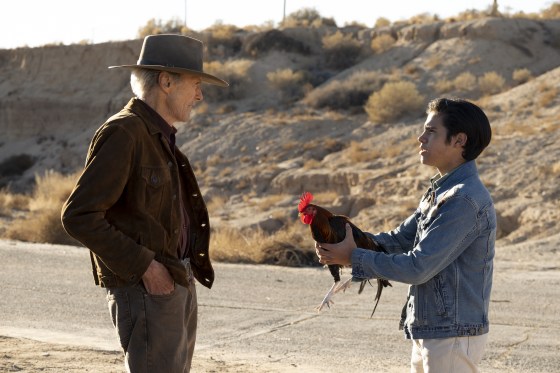
Claire Folger Copyright: © 2021 Warner Bros. Entertainment Inc. All Rights Reserved.Clint Eastwood, Eduardo Minett and rooster.

Stalwart Mike resists. Besides, he’s already located Rafo—and met the boy’s prize rooster, a flinty, handsome creature named Macho—and senses that the kid isn’t as tough as he thinks he is. The two set off on a desert odyssey that involves stolen vehicles, some lessons in training wild horses, and pleasant days and evenings spent in a café owned by a kind, observant, gorgeous middle-aged widow named Marta (Natalia Traven). The sparks between Mike and Marta fly, or at least skitter toward one another with resolute, shuffleboard-style jauntiness.

Read more reviews by Stephanie Zacharek

Shot by Ben Davis, Cry Macho has a handsome, muted sheen: Its vistas of dusty purple clouds and ochre desert plains evoke warm winds and the slow passage of time. The material itself—written by Nick Schenck and N. Richard Nash—has some age to it: Eastwood first became aware of it some 40 years ago, and it bounced around Hollywood for decades with no luck, until Eastwood remembered it and sought to bring it to life.

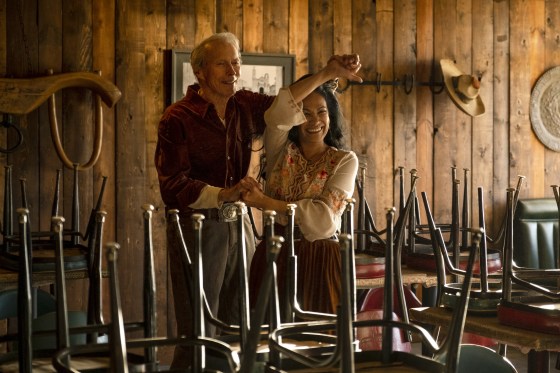
Clint Eastwood and Natalia Traven

And through it all, he pokes along with admirable energy. In his long and fertile career, Eastwood has sometimes been a great director and often just an O.K. one. But in recent years, movies like The Mule and Gran Torino have brought us some unexpected riches of crankiness. In these pictures, Eastwood no longer tries to hide his age, because he knows he no longer can. He confronts the indignities of old age with a surly, comforting growl. In Cry Macho, he’s slim and straight as a rod, and his every movement says, “Don’t worry about me, kid.” Damned if it doesn’t feel like a blessing—because who wants to have to worry about eternal legend Clint Eastwood?

I do wonder what 91-year-old actress could—or would—cast herself in a movie where she finds redemption and tender love with a man at least 30 years younger than she. The idea seems unimaginable, maybe partly because most spry 91-year-old women have a lot more on their minds than the pursuit of younger men—too many museums to go to, operas to attend, mahjongg games to play. But if Eastwood can get away with his old-dude fantasies, or even almost get away with them, why not? Sometimes a man has to believe he’s still got it, that the attractive younger señora wants nothing more than, for the rest of his days, to hold him close in a charming café lit by ultra-symbolic sunset. If this fantasy means so much to a man, it’s an act of kindness to let him have it.

Today news: Norm Macdonald’s Comedic Genius Explained in One Brilliant Joke


Norm Macdonald was responsible for some of the worst punchlines in Hollywood history.

“There are times when Bob has something on his mind—when he wears a hat!” the comedian proclaimed stone-faced at Comedy Central’s Roast of Bob Saget in 2008, as Saget, his target, chuckled with clear confusion and discomfort. As the room grew quiet, unmoved by the joke, Macdonald decided not to move past the clear dud, but instead to double down: “No thoughts at all—JUST A HAT!”

But it was exactly this type of delivery and commitment that made Macdonald, who died on Tuesday after a long, private battle with cancer, one of the most unique and irreplaceable voices in modern comedy. Macdonald thrived on the edge of convention and in moments of silence and discomfort; through his unique approach, he weaved the dumbest punchlines into comedic masterclasses. And while other comics turned their desire to provoke into an excuse to bully or punch down, Macdonald’s transgressions were usually more conceptual: he thumbed his nose at the art form of the joke itself.
[time-brightcove not-tgx=”true”]

Norm Macdonald
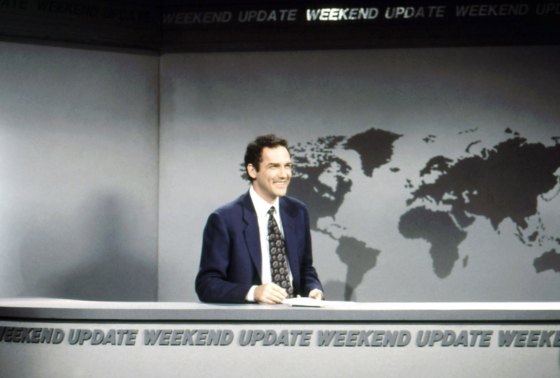
NBC—Everett CollectionNorm Macdonald during the Weekend Update segment on Saturday Night Live on Dec. 14, 1996.

From “Weekend Update” to icon status

Norm Macdonald joined Saturday Night Live in 1993—his Burt Reynolds impression on the recurring Celebrity Jeopardy sketches was unforgettable—and later became the anchorman of “Weekend Update,” developing a reputation as a sardonic livewire liable to veer dangerously off script. (At the ESPYs in 1998, his joke about O.J. Simpson left its target, Charles Woodson, shaking his head in disgust as if he had been tackled on the football field.) Though he would lend his voice to or make cameos in many movies throughout his career, the one he co-wrote and starred in, 1998’s Dirty Work directed by Saget, bombed. He was fired from SNL that same year, allegedly due to his repeated jokes about O.J. Simpson, who was friends with an NBC executive.

But somehow, his failures led to much greater success. “I got demoted at SNL, and then I got sort of hot,” Macdonald told Rolling Stone in 1999. “Then the movie didn’t happen, and then I got really hot.”

After that point, Macdonald became one of the most respected and beloved comics to younger generations, primarily through stand-up sets and late-night appearances. There are unspoken rules for comedians appearing on late night shows: be succinct and amiable, play nice with the other guests, plug your movie, keep it moving. One of Macdonald’s comedic inheritors, the fellow Canadian Nathan Fielder, recently skewered those conventions on an episode of Nathan For You.

But Macdonald was working in that space first, gleefully undermining hosts at every turn and egging on confrontation, a mischievous smile preceding every provocation. “In all sincerity, I know you don’t like to hear these things and emotions—you’re like Nixon,” he said straight to David Letterman’s face. At a daytime appearance with the Lonely Island, he said to the trio, with a glint in his eye: “I call them [Andy] Samberg and the other couple of fellas.”

His most frequent sparring partner was Conan O’Brien. Over more than two decades, Macdonald came on O’Brien’s show regularly to tell story after incoherent story, to O’Brien’s mock chagrin (and underlying delight). In 1997, he completely derailed a now-infamous interview with Melrose Place star Courtney Thorne-Smith, mocking her career trajectory and her new movie Chairman of the Board: “I bet the ‘Board’ is spelled ‘B-O-R-E-D,’” he exclaimed, causing Thorne-Smith to cover her face and O’Brien to jump out of his chair.

A singular style encapsulated by one cheesy joke

One of the most famous, and funniest segments Macdonald ever had on O’Brien’s show came in 2017. Over four bumbling minutes, Macdonald weaves a story, now referred to as “the moth joke,” about a depressed Russian moth at a podiatrist’s office, delivering each increasingly dark line with a mixture of eloquence and awkward, halting cadences; he steamrolls unperturbed over every one of O’Brien’s interjections. When he finally arrives at the punchline, it is as obvious and juvenile as can be—but his ability to build tension, to keep the audience wrapped around his finger, to place himself deeply within his own absurdist story, and his exultant delivery of a punchline he himself knew was cheesy all contributed toward making the joke an all-timer.

Macdonald was a man of his time; he made plenty of racially-based and gender-based jokes that would be considered offensive by today’s standards. Off-color comments he made in 2018 while promoting his new show made it clear that he was out-of-step with the current comedic moment. But his impact on the next generation is immeasurable. Colin Jost has said he modeled his “Weekend Update” persona after Macdonald’s; Seth Rogen also said he “ripped off his delivery” at the start of his career.

It’s easy for comedians to try to be scandalous and undermine conventions—but much harder to make such unfunny material so hilarious. After a particularly groan-inducing punchline on Conan in 2014, Andy Richter scolded him: “It’s like somebody saying, ‘I gotta show you something,’ and then they take you on a four mile hike to show you a dog turd.” But the overflowing laughter of the trio told a different story. Many have tried to replicate his cringey success—but there will never be another Norm Macdonald.

Today news: How This Fall Could Shape the Future of Moviegoing


Everyone has the tea leaves; no one has the actual tea. Will the movies come back this autumn? Will they ever come back at all?

The answer is…that no one has the answer. There’s little wisdom to be had, and any wisdom out there is hardly conventional. What we do know is that the fall 2021 movie release calendar is unlike anything we’ve seen in years: more varied, more exciting, more studded with actors we really want to see. Timothée Chalamet and Zendaya jet into the future for Denis Villeneuve’s earnest and vivid adaptation of Frank Herbert’s supposedly unfilmable sci-fi epic Dune; Adam Driver and Lady Gaga swan through Ridley Scott’s juicy-looking House of Gucci (just one of three movies Driver stars in this fall, two of them directed by Scott); Oscar-winning Nomadland director Chloé Zhao tries her hand at the superhero genre with Eternals, starring Salma Hayak and Angelina Jolie. There’s more, like the long-delayed Bond thriller No Time to Die, as well as the wild Cannes Palme d’Or winner Titane, which redefines the notion of what makes a car sexy. And the early fall festivals—Venice, Toronto and Telluride—poured even more jewels on the treasure pile, like Pedro Almodóvar’s ardent melodrama Parallel Mothers, Paul Schrader’s serrated redemption romance The Card Counter and Jane Campion’s gorgeous and perceptive western The Power of the Dog.
[time-brightcove not-tgx=”true”]

The big question is whether people will rush to see these movies in theaters or, their curiosity piqued, just wait until they’re available to stream. (Dune will have a dual release in theaters and on HBO Max.) Until a few months ago, everyone thought that movie fans—vaccinated ones, that is—would flock to theaters for big-ticket comedies and comic-book movies but would be more likely to watch more adult-oriented movies via streaming. That has proved to be only sort of true. Box-office returns for Black Widow, released simultaneously in theaters and via streaming, were disappointing. But the Ryan Reynolds comedy Free Guy and the Aretha Franklin biopic Respect—both launched only in theaters before being made available via streaming—lured a respectable number of moviegoers from their pandemic-era lairs.

And still, it all means nothing, especially with valid fears about the Delta variant swirling around us: this may not be the fall we return to theaters. So for now, it may be helpful to concentrate less on the question of “Will moviegoers return?” and more on “Do moviegoers want to return?” Because, in the end, whenever it truly is safe to venture back into theaters, that question will hinge on the desire of human beings—that is, potential ticket buyers—for a specific experience.

People who want to go back to the movies really want to go back; their idea of what movies can and should be hinges on a vision writ large in their imagination. Other, more indifferent viewers are happy to welcome the new delivery methods, depending on what’s most convenient for them. Either way, studios will find ways to make money off their products—and evidence suggests that most of them don’t care where or how you watch, as long as they make their money.

Everyone who continues to declare that movies watched big, with an audience, are over should stop to think about what this future, if it happens, will really mean. Already, even after just a year and a half of enforced (or semi-enforced) pandemic-era at-home viewing, the streaming pipeline is half clogged with products half-heartedly masquerading as movies: For every Netflix-backed Scorsese project, there are multiple Christmas Prince or Kissing Booth entries, a generic action picture like Extraction or a limp drama like The Last Thing He Wanted—a whole raft of movies that that end up being something almost nobody remembers having watched. That’s not to say movies in the latter group aren’t enjoyable on some level. And plenty of unmemorable, low-budget fare found its way to movie screens long before streaming existed. But even those who’ve happily given up on the idea of ever going back to the movies should ask themselves if this mishmash selection is really what they want.

We should also be careful about who is telling us—even indirectly—that streaming is the new and ideal model. Disney, in addition to owning the Marvel and Star Wars franchises, subsumed 20th Century Fox in 2019 and launched its own streaming service, Disney+, just a few months later. Recent executive shakeups at ViacomCBS, owner of Paramount Pictures, suggest the company is shifting away from big theatrical releases and looking to squirt more product through its own streaming service, Paramount+. The companies that used to make big-screen movies now have a great deal invested in feeding you a steady diet of small-screen ones. Why wouldn’t they be working overtime to convince us that it’s better, easier, and cheaper to watch movies at home, now that they see which way the money funnel is pointing? All the better if they can make it look like it was our idea in the first place—that way they can pretend they’re merely offering us a wonderful service (for a price), rather than killing off movies as we know them.

The new system is adequate, if somewhat soul-killing, if you just want to sit on your couch and have something, anything, new to watch every few days. And yes, you’ll still see some terrific movies that way. (Campion’s The Power of the Dog arrives on Netflix in late December, and even though the movie’s glorious vistas deserve an expanse bigger than even most big-screen TVs, the story should be enough to hold you. And among the streaming services, Netflix at least shows some commitment to keeping the theatrical experience alive, as does Amazon.) But I still don’t think the rise of streaming spells the end of big-screen movie watching. We need to think about who has a stake in keeping that experience alive—and increasingly, it’s not the big studios. Movies will be kept alive by people who care about them as artistry first and a means of making big bucks second. Streaming just may become the major delivery system for what we used to think of as big-studio theatrical releases. But smaller, smarter films aimed at grown-ups may be the ones that save the movies.

There are always people who want to feel that they’re plugged into the larger world, who want to be able to see the smaller or non-Hollywood movies they read about—films by Pedro Almodóvar or Pablo Larraín or Claire Denis—on the big screen. Admittedly, there are going to be places in the country, and the world, where that’s just not possible. But is there a chance that the streaming revolution might strengthen, rather than chip away at, people’s desire to see a certain kind of movie on the big screen? There’s a certain type of person—you know who you are—who doesn’t want to spend even one more minute cooped up at home. We don’t know how many of those people there are, but our pandemic experience may end up being a good thing for cities and towns that already have art-house cinemas. And is it possible that the new world awaiting us—one we can’t yet step out into, safely—might actually be hospitable to a new wave of smaller, independent movie theaters, designed to serve all of those who have never stopped caring about movies? Stranger things have happened: in music, vinyl has been kept alive by boutique enthusiasts of all ages, while CDs—though still beloved by some—are as quaint as gramophone records.

In the end, it’s too convenient to point to the pandemic as the single biggest factor in shifting moviegoing habits. More realistically, our months—now stretching into more than a year—of semi-confinement merely exacerbated or accelerated changes that were already under way. But however we got here, and wherever we’re going, we should treat this abundant autumn as a blessing, a reward for having survived a trying time. The future of movies is unwritten—but let’s get through this harvest, a rich one, before we chisel the epitaph.

There’s Always Been More to Kirsten Dunst


By Kyle Buchanan via NYT Movies https://ift.tt/2VxVFLp
 
Copyright 2009 Great Movies Database News. All rights reserved.
Free WordPress Themes Presented by EZwpthemes.
Bloggerized by Miss Dothy