RSS
Hello! Welcome to the Great Movies Database.

Today news: Olivia Colman Is Extraordinary in The Lost Daughter, Maggie Gyllenhaal’s Bold Directorial Debut


For her directorial debut, Maggie Gyllenhaal has chosen a complicated project, a movie that winds through complex emotional corridors that would challenge even an experienced filmmaker. That makes the feat she pulls off with The Lost Daughter—playing in competition at the 78th Venice Film Festival and hitting U.S. theaters and Netflix in December—that much more remarkable. Olivia Colman stars as Leda, a British academic on holiday in Greece—she has packed her luggage with books, half-apologizing for all the extra weight to the caretaker, Lyle (Ed Harris), who greets her at the property she’s rented. She finds a good spot on the beach and settles in. A charming Irish student named Will (Paul Mescal), working on the island for the summer, gallantly offers to move her chair out of the sun and into the cooling shadow of a beach umbrella. With her books, her beach chair and an ice-cream Will has brought her, she’s ready for some glorious languor.
[time-brightcove not-tgx=”true”]

Then a noisy, boorish and very large American family invades the beach. The men are belligerent for no reason; the women seem sly and manipulative. One of them, the fortyish Callie (Dagmara Dominczyk), strides over to Leda to ask her to move her umbrella and beach chair, to make more room for her sprawling family. Leda refuses; she’s prickly, defensive, but you get where she’s coming from—it’s always the woman alone who’s expected to move her beach chair, to accommodate others in some way, in a manner that doesn’t apply to men. Miffed, Callie slinks away, but returns later with a slice of birthday cake, intended as a peace offering. Leda is more hospitable this time, and the two women discuss Callie’s pregnancy, evident from her swelling tummy. Callie seems to be anticipating—or demanding—some soothing, platitudinal advice. Instead, Leda tells her, her mind suddenly having traveled elsewhere, “Children are a crushing responsibility.”

We learn why Leda feels that way as her backstory unfolds, revealed in a lattice of flashbacks through which we eventually see the whole picture: As a young wife and mother who’s building her academic career (her field is Italian literature), Leda—played in her younger incarnation by Jessie Buckley—is doing her best to raise her two daughters, but her nerves are frayed. Her husband seems oblivious to it all. A flirtatious fellow academic (played by Peter Sarsgaard) takes an interest in her, and she succumbs to an affair. All of this comes back to the older Leda—and is revealed to us—as she becomes fascinated by Callie’s sister-in-law, Nina (Dakota Johnson, in a nervy, brittle performance), a young mother herself. Leda observes Nina on the beach with her young daughter, who seems willful and moody. She and Nina strike up a tentative friendship, though Nina, slinky and appraising, seems to be eyeing Leda for what she can get out of her, though what that might be isn’t immediately clear.
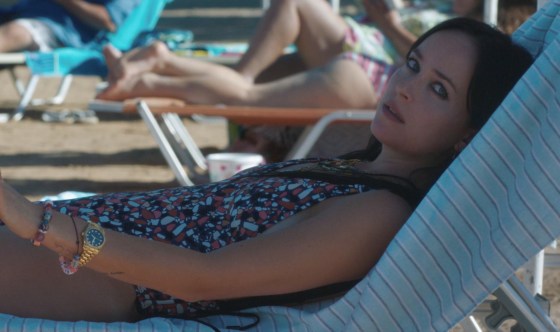
THE LOST DAUGHTER: DAKOTA JOHNSON as NINA. CR: NETFLIX © 2021
NETFLIX © 2021—© 2021 Netflix, Inc.Dakota Johnson in ‘The Lost Daughter’

The Lost Daughter is a lot to take in. (Gyllenhaal adapted the script from the 2006 Elena Ferrante novel of the same name.) Leda behaves a bit oddly: she’s socially awkward, often direct to the point of being unlikable. But she’s also kind, willing to reach out to help others who may be drowning, as she once was. Colman gives a marvelous performance, as a woman well into middle age whose spiky edge hasn’t been, and probably never will be, completely smoothed: she’s a mix of nettles and swan’s down, and you never know what you’re going to get. By the movie’s end, you feel you’ve come to know a complex and wholly believable human being.

And at the core of The Lost Daughter is a daring and dangerous idea: It’s an exploration of what motherhood can drain from a woman—a dramatic switch from the typical glassy-eyed bromides about how rewarding it is to bear and raise children. Buckley is terrific, her performance meshing so perfectly with Colman’s that it’s easy to see the older woman within the younger one, and vice-versa. Both Colman and Buckley are skilled, gifted performers, but the movie’s themes are demanding and tricky; I could imagine some people being repelled by them. Gyllenhaal shapes these ideas beautifully, in a way that feels searching and exploratory, never judgmental. And you get the feeling she’s fallen a little in love with her actors. That’s not a requirement for every movie, but perhaps for one like this, which dives so deeply into the soul of a woman who had to seize her own happiness, that extra bit of tenderness can make all the difference.

To call The Lost Daughter an assured debut is to do it a slight disservice—assurance suggests that a filmmaker knows everything going in. What we see in The Lost Daughter is something greater: the act of discovery—of the gifts actors can bring to a story, of how to hold a complex narrative together—in progress. That’s what makes this movie so effective, so occasionally troubling, and so alive. Gyllenhaal lets us ride the learning curve with her.

Read more reviews from the Venice Film Festival:

Penélope Cruz Gives One of the Best Performances of Her Career in Pedro Almodóvar’s Parallel Mothers

Jane Campion’s Gorgeous Western The Power of the Dog Is a Sharp Study of Masculinity Gone Awry

Oscar Isaac Smolders in the Pensive Romantic Thriller The Card Counter

Kristen Stewart and Pablo Larraín Do Princess Diana Wrong in Spencer

Denis Villeneuve’s Take on Dune Is an Admirably Understated Sci-Fi Spectacle

Edgar Wright’s 1960s Fever Dream Last Night in Soho Is a Half-Brilliant Thriller

Today news: Girls Aloud Star Sarah Harding Dies at 39 After Breast Cancer Fight


LONDON — Singer Sarah Harding of the British pop group Girls Aloud has died after a battle with breast cancer, her mother said Sunday. She was 39.

=+ On Sunday, her mother Marie said on Instagram: “It’s with deep heartbreak that today I’m sharing the news that my beautiful daughter Sarah has sadly passed away.”

“Many of you will know of Sarah’s battle with cancer and that she fought so strongly from her diagnosis until her last day. She slipped away peacefully this morning,” she wrote. She added that Harding was a “bright shining star” and would have wanted to be remembered for that, rather than for her fight against cancer.

Harding said earlier this year that she was told by a doctor that she will likely not be alive next Christmas. In her autobiography, released in March, she said she decided to announce her illness in the hope that others who have concerns would seek medical help and not leave a cancer diagnosis until it’s too late.

Harding found fame in 2002 as a contestant on the ITV talent show “Popstars: The Rivals,” which paved the way for her joining Girls Aloud alongside Nicola Roberts, Kimberley Walsh, Cheryl Tweedy and Nadine Coyle.

The group had several hits including “Sound of the Underground,” “Love Machine” and “The Promise” before it split up in 2013.

After Girls Aloud, Harding appeared in several movies and television shows as well as a stage adaptation of “Ghost” the movie. She won the reality show “Celebrity Big Brother” in 2017.

Today news: Edgar Wright’s 1960s Fever Dream Last Night in Soho Is a Half-Brilliant Thriller


Some of us have memories of things that didn’t even happen in our lifetimes. We’re drawn to a specific era, or certain relics of the past, for reasons we can’t explain. Why are we sometimes drawn to music and movies and clothing that speak to the people we might have been had we been born 10, 50 or 100 years earlier? Is there a word for the nostalgia we feel for a life we never actually lived, but wish we had?

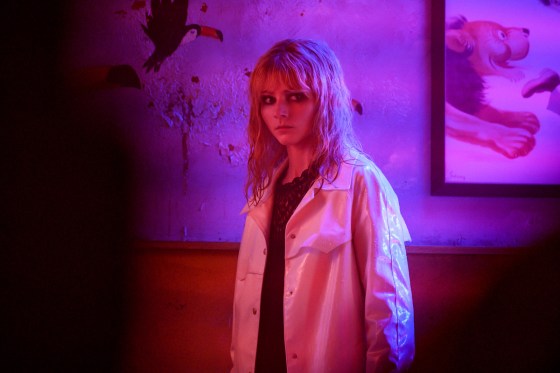
Whatever that word is, Thomasin McKenzie’s character in Edgar Wright’s half-brilliant thriller Last Night in Soho—playing out of competition at the 78th Venice Film Festival—is the poster girl for it. McKenzie plays Ellie, an aspiring fashion designer and third-generation seamstress who takes pride in being able to make her own clothes, to create any vision of herself she pleases. This is something Wright shows us, rather than tells us, in the movie’s stunning opening scene: We see Ellie dancing down a hallway—the song is Peter and Gordon’s gorgeously wistful 1964 “A World Without Love”—and into her teenage bedroom, wearing a smashing early-1960s-style bouffant dress cleverly made from newspapers. Her room, and her LP collection, constitute a shrine to a past that’s not her own: CARNABY is spelled out in cartoonish letters on her bedroom door; she’s crazy about Cilla Black and the Kinks, music that was pouring out of transistor radios long before she was even a tadpole.
[time-brightcove not-tgx=”true”]

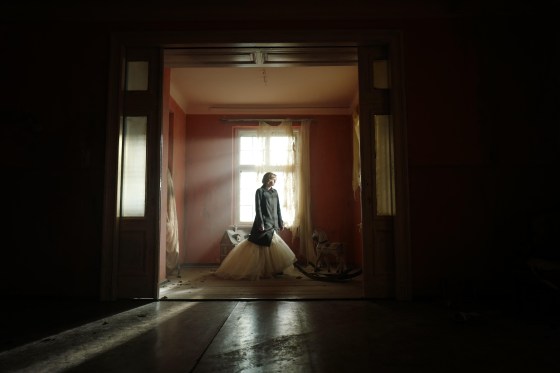
'Last Night in Soho'
Parisa Taghizadeh / Focus FeaturesThomasin McKenzie in ‘Last Night in Soho’

Read More: The 23 Most Anticipated Movies of Fall 2021

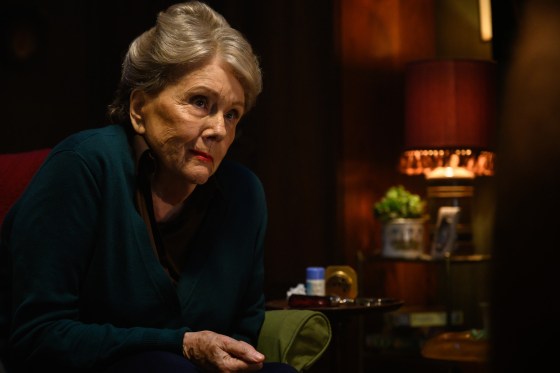
Ellie lives with her grandmother in Cornwall. Her mother has been dead for more than 10 years, though Ellie has a gift—her mother periodically appears to her in vivid, realistic visions. When Ellie moves to London to study fashion design—after a run-in with a terrible roommate, she rents a top-floor room from a kindly landlady, played by Diana Rigg in one of her final film roles—her hypersensitive powers of perception kick into overdrive. When she goes to sleep at night, she’s zapped to the London of the mid-1960s, where she becomes the mirror-twin of a glamorous aspiring signer named Sandy (Anya Taylor-Joy). Sandy, alluring in a blond Catherine Deneuve bob and swooping eyeliner, has invaded Ellie’s dreams, both seducing her and inspiring her—at school, during her waking hours, Ellie’s designs are on fire, and she strikes up a flirtatious courtship with an adorable classmate (played by Michael Ajao).

If the first third of Last Night in Soho were a movie unto itself, it would be one of the most stylish and seductive pictures of the year, an affectionately rendered love letter to an era that Wright himself is too young to remember but clearly loves. When Sandy takes the stage during an audition for an a capella rendering of the Petula Clark hit “Downtown,” my heart skipped a beat. I was four when this song came out, and it represented everything I wanted in life at the time: City lights, a pink chiffon dress and a pair of silver slingback shoes. All three of those things, and more era-specific delights, are right there in Wright’s movie, as if he had read my own plaintive childhood desires and put them onscreen.

But Last Night in Soho takes a sharp and suddenly dark turn. (The movie was cowritten by Wright and Krysty Wilson-Cairns.) That isn’t a problem in itself, if you consider, say, David Lynch’s Mulholland Dr. as a model: The first half of that picture is a dream you don’t want to wake up from; the second half is the nightmare price you pay for buying the dream, but it too is an opiate reverie, and it provides context for all that came before it. That movie’s second half is like a blackened-gold setting for the diamond of the first.

'Last Night in Soho'
Parisa Taghizadeh / Focus FeaturesDiana Rigg stars as Ms. Collins in ‘Last Night in Soho’

To reveal too much of Last Night in Soho would be unfair to the movie and to anyone who’s eager to see it. But at a certain point, the plot becomes disappointingly unwieldy; by the end, it has cracked into dozens of irreconcilable pieces, turning us against characters we want to sympathize with and trying to draw out sympathy for others who don’t deserve it. It’s wonderful that Wright has cast three marvelous 1960s actors in his movie: Rigg, Terence Stamp and Rita Tushingham (maybe best known for her role in the 1961 A Taste of Honey). But Stamp’s role is pointless and weirdly truncated, a waste of an actor who, gorgeous at age 83, is one of our great silver lions. And although Wright dedicates the movie to Rigg, her character gets a jarring, thankless arc. Last Night in Soho soars at the beginning, only to crash in the end. It’s a broken promise—a downtown that, unlike Petula’s, only lets you down.

Read more reviews from the Venice Film Festival:

Penélope Cruz Gives One of the Best Performances of Her Career in Pedro Almodóvar’s Parallel Mothers

Jane Campion’s Gorgeous Western The Power of the Dog Is a Sharp Study of Masculinity Gone Awry

Oscar Isaac Smolders in the Pensive Romantic Thriller The Card Counter

Kristen Stewart and Pablo Larraín Do Princess Diana Wrong in Spencer

Denis Villeneuve’s Take on Dune Is an Admirably Understated Sci-Fi Spectacle

Today news: HBO’s Scenes From a Marriage Remake Is Trying to Break Your Heart, All Over Again


Ingmar Bergman’s Scenes From a Marriage is a dance between emotional realism and theatrical artifice. The 1973 miniseries, which aired on Swedish TV and screened internationally in an abridged feature cut, traces a tumultuous decade in the life of an upper-middle-class couple, played by Liv Ullman and Erland Josephson. Working with a miniscule budget, Bergman didn’t even attempt an immersive mise-en-scène; his talky vignettes play out in sparsely furnished spaces that evoke stage sets more than real rooms. Yet the minimal backdrops throw the performances—especially that of Ullman, whose life-altering relationship with Bergman helped inspire the project—into relief. Liberated from cinematic naturalism, the characters’ intimate, impassioned exchanges achieve the heart-rending immediacy of live theater.
[time-brightcove not-tgx=”true”]

HBO’s Scenes From a Marriage, a contemporary, American remake that premieres on Sept. 12, nods to this illusion-puncturing aesthetic. Most episodes open with one of the two leads, Oscar Isaac and Jessica Chastain, walking onto the set, surrounded by crew members whose face coverings date the production to the COVID era. We see that the house where the central characters, Jonathan and Mira, live, and where the vast majority of the action takes place, is on a soundstage. It’s as if writer-director Hagai Levi (In Treatment, The Affair) is challenging himself to so deeply engage viewers in this couple’s crisis that we forget what he’s just told us about its artifice. This gambit, like the series as a whole, neither fully succeeds nor totally fails.

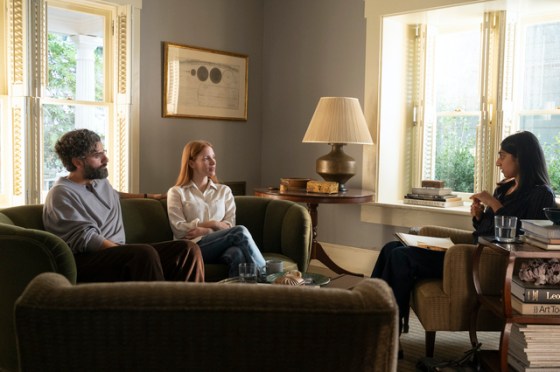
When we meet Jonathan and Mira, they’re sitting for an interview about their ostensibly happy decade of marriage, with a PhD student (Sunita Mani of GLOW) from the college where Jonathan teaches philosophy. “I’m looking at how evolving gender norms affect monogamous marriages,” the young woman explains. It’s a clever, if unsubtle, way of introducing what constitutes a loosely gender-swapped version of Bergman’s Scenes. While Ullman’s family-lawyer character pulled a second shift of housework and childcare, Chastain’s tech executive might as well live at the office. The male half of the couple is an academic in both incarnations, but where Josephson’s arrogant, ambitious character spent his off-hours out of the house, Isaac’s introverted professor does the bulk of the domestic labor. (Does this constitute a commentary on the declining cachet of a career in academia? It’s possible!) Jonathan’s identity is inextricably linked to home and family; Mira’s revolves around her work outside that sphere.

His disproportionate investment in their marriage creates an imbalance, and Scenes is the story of how that power pendulum, once put into motion, keeps swinging between the spouses for years. Levi seamlessly modernizes the scenario, inserting iPhones and Airbnb, startup bros and Morning Pages in clever places. He’s at his best when straying farthest and most confidently from Bergman’s outline. The choice to cut the second, weakest episode of the six-part original, paring the HBO version down to five hours, is a good one. Also inspired is Levi’s characterization of Jonathan as a lapsed Orthodox Jew, whose religious upbringing can be both an obstacle and a comfort to him. (Why, though, is Mira’s background left almost entirely blank?)

Jojo Whilden/HBOFrom left: Oscar Isaac, Jessica Chastain and Sunita Mani in ‘Scenes From a Marriage’

Levi occasionally raises timely, even provocative questions. At one point, Mira starts a physical altercation with Jonathan; after she’s been pummeling him for a good long while, he hits back. Despite all the talking we’ve done recently, as a culture, about intimate partner violence and abuse, situations as dangerously messy this one—spontaneous fights, fights between separated partners, fights initiated by the woman in a heterosexual couple—have become rare onscreen. Most current TV creators prefer their moral dilemmas either cut-and-dried or so complex, they take several episodes’ worth of agonizing conversations to unravel. Instead of being strident or prescriptive or obvious, Scenes declines hand-holding duties as the audience processes its discomfort.

But because the series repurposes so much from Bergman, it would be impossible not to measure it against the original and find the new version somewhat lacking. The performances, as crucial here as they would be in a Shakespeare adaptation, are solid. Isaac has played a lot of hubristic jerks, in movies like Ex Machina and Inside Llewyn Davis; he would’ve been a lock for a character more like Josephson’s, yet here he radiates a softness that stops short of undermining his masculine demeanor. Chastain isn’t quite as consistent, but her sporadic stiltedness underscores how Mira is always performing her self-sufficiency and competence. Still, neither star comes close to equaling Ullman’s symphony of loud, quiet and silent emotion.

Even more conspicuously absent is the social context of Bergman’s Scenes. Aired as the movement known in the U.S. as second-wave feminism was sweeping the West, it barely mentioned politics as such. But its story arc—a formerly repressed woman finds independence just as her once-overconfident husband is realizing the limits of his autonomy—resonated with viewers the world over. At that particular moment in history, against backdrops so generic they could be anyone’s home, Ullman’s and Josephson’s characters became archetypes. So influential was the miniseries in Sweden that it’s said to have caused a spike in the divorce rate.

Nearly half a century later, the zeitgeist isn’t exactly working in favor of HBO’s Scenes. For one thing, a pandemic, an unprecedentedly conservative Supreme Court, ongoing economic calamity and a summer of extreme weather events tied to global warming can make it hard to care too much about the emotional vicissitudes of a bourgeois marriage. Divorce is hardly as exotic in 2021 as it was in 1973. And while there are certainly couples that resemble Levi’s characters these days, it’s not like men are suddenly shaking off a millennia-old history of oppression at the hands of women. Mira is just Mira; Jonathan is just Jonathan.

That’s hard to overlook when we’ve seen so many fresher depictions, over the past few years, of couples trapped in personal hells, from Noah Baumbach’s openly Bergman-indebted Marriage Story to Lena Waithe and Aziz Ansari’s lesbian saga Master of None: Moments in Love to Sally Rooney’s novel turned miniseries Normal People. If both the original Scenes From a Marriage and Levi’s remake had been actual stage plays, the new version might have made for a perfectly satisfying revival. Instead, it’s a better-than-average TV show adapted from a masterpiece that you can still watch in the comfort of your all-too-delicately constructed home.

Venice Film Festival: ‘Dune’ Leaves Us With 3 Big Questions


By Kyle Buchanan via NYT Movies https://ift.tt/3yHWHls

Today news: Denis Villeneuve’s Take on Dune Is an Admirably Understated Sci-Fi Spectacle


To call Denis Villeneuve’s science-fiction extravaganza Dune a good example of its type of thing is probably damning it with fainter praise than it deserves. As someone who has zero interest in most books beloved by proselytizing, glassy-eyed dudes of the 1970s and 1980s, I always figured I could never be a Dune person. But I sort of enjoyed Villeneuve’s Dune—premiering out of competition at the Venice Film Festival and opening in the United States later this fall—and though it’s hard to say if serious Dune dudes will approve, what Villeneuve has put onscreen proves, at the very least, that he respects the source material to just the right degree. He neither genuflects to it nor tries to tart it up as a flashy, self-satisfied blockbuster flimflam. As movie spectacles go, it’s admirably understated: What can you say about a movie that makes the absolute most of sand?
[time-brightcove not-tgx=”true”]

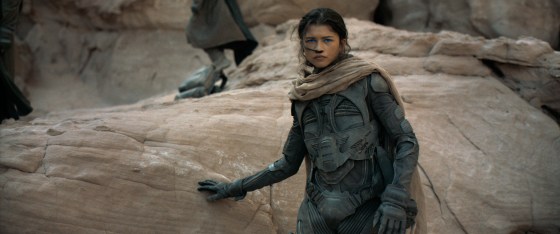
Frank Herbert’s 1965 novel has long been considered unfilmable: Chilean-French filmmaker Alejandro Jodorowsky tried, unsuccessfully, to tackle it in the 1970s, and David Lynch’s 1984 version was widely viewed as a disappointment. Admittedly, Villeneuve (Arrival, Blade Runner 2049) has a bunch of modern filmmaking tools available to him that those filmmakers didn’t, but at least he makes good use of them. The story is set in the year 10191, on a dry desert planet, Arrakis, that’s rich in “spice,” a substance needed for interplanetary travel. The planet’s longtime inhabitants are the Fremen, desert people who have found ways to survive in a harsh environment—one of their mysterious and dignified denizens, Chani (Zendaya), shimmers into view in a series of dream sequences, before materializing in real life.

Dune
Courtesy of Warner Bros. Pictures and Legendary PicturesZendaya as Chani in ‘Dune,’ which premiered at the Venice Film Festival

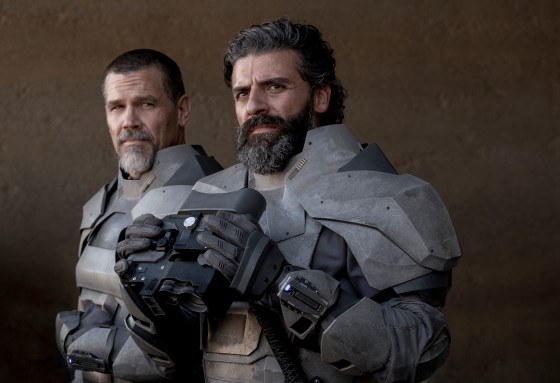
For the Fremen, spice is a consciousness-enhancing substance, and they value it dearly. But other inhabitants of their interplanetary network think nothing of harvesting all the spice they want, giving the Fremen people nothing in return. (Dune, in case you haven’t guessed, is heavy with geopolitical and religious symbolism of all sorts.) The emperor of all the planets puts the head of a noble family, Duke Leto Atreides (Oscar Isaac, in a woolly gray beard), in charge of Arrakis. Atreides intends to be fair and benevolent. But when he moves to this unwelcoming, parched planet with his concubine, Lady Jessica (Rebecca Ferguson), and his teenage son, Paul Atreides (Timothée Chalamet), it becomes clear the emperor has drawn him into a web of deceit.

Dune
Chiabella James © 2020 Warner Bros. Entertainment Inc. All Rights Reserved.Josh Brolin and Oscar Isaac in ‘Dune’

Lots of stuff happens in Dune, and this is only part one. (Villeneuve has expressed confidence that he’ll be able to finish the story in a second installment.) There are many scenes of flying vehicles buzzing about like iron dragonflies. Warriors go to battle with shimmery swords, their skin sizzling when they’re struck or wounded. Little mechanical bugs can shoot right into your skin and immobilize you before killing you, slowly. Jessica, one of the movie’s most compelling and enigmatic characters, is a member of an all-woman secret society with mystical powers. At one point, that group’s mother superior, played by Charlotte Rampling in a black beaded nun’s veil, tests young Paul’s fortitude by forcing him to stick his hand into a nasty box of pain, a gizmo the size of a box of tissues. His suffering is intense, and the anguish shows on his little acorn face—but then he gets used to it, and suddenly it’s no biggie. Previously skeptical mother superior has to admit to Jessica, the anxious mom, that this lackadaisical teenager just might have special powers of his own—but the jury is still out.

Because, of course, Dune is largely a story about a young man proving himself. Villeneuve presents this tale as an unapologetically poker-faced futuristic parable. There are characters with names like Duncan Idaho (who happens to be played, charmingly, by Jason Momoa), and everyone is waiting for someone known as the Kwisatz Haderach to show up. Villeneuve lays it out before us without smirking or winking; his go-for-broke earnestness feels honest and clean. And the effects, while lavish, also have a tasteful, polished quality. Particularly impressive is the massive Arrakis predator known as the sandworm, a fearsome creature that first makes its presence known as a giant ripple of action beneath the sand, before poking its lamprey-like head aboveground to sweep its prey—machinery, people, whatever—into its toothy gob. The sandworm is the stuff of nightmares, but Villeneuve’s vision of it has a shivery elegance. Dune is sluggish in places—my eyes glazed over during one or two or maybe three of the battle scenes—but Villeneuve’s conviction counts for a lot. I would probably sit through Dune Part Deux willingly—though Herbert’s book, I’m afraid, will remain forever unread.

Read more reviews from the Venice Film Festival:

Penélope Cruz Gives One of the Best Performances of Her Career in Pedro Almodóvar’s Parallel Mothers

Jane Campion’s Gorgeous Western The Power of the Dog Is a Sharp Study of Masculinity Gone Awry

Oscar Isaac Smolders in the Pensive Romantic Thriller The Card Counter

Kristen Stewart and Pablo Larraín Do Princess Diana Wrong in Spencer

Today news: Kristen Stewart and Pablo Larraín Do Princess Diana Wrong in Spencer


Kristen Stewart is a tiger in actor form, one of our most gifted and understated young performers. Her fearlessness is the casual kind, arriving without fanfare or advertisement—languid one minute and ready to leap the next, she’s a master of the slow blink. When the news came out that Jackie director Pablo Larraín had cast her as Princess Diana, it sounded as if genius had struck with the perfectly tuned tinkle of a sterling dinner bell. Stewart would be just the person to capture Diana’s coquettish vulnerability—and to wear the movie equivalent of her elegant and distinctive wardrobe, clothes that seemed to give the sad princess so much pleasure to wear that it made you feel grateful for the existence of sheep and silkworms. That poor woman, married to a dud prince and stuck in a meat grinder disguised as a royal family, deserved to have some joy in her life.
[time-brightcove not-tgx=”true”]

But Spencer, the movie Larraín has now delivered—premiering at the 78th Venice Film Festival—feels less a cry of the heart than a parody of a parody, and through no fault of Stewart’s. The setting is the Christmas holiday, sometime in the late 1980s. Diana is due to appear at Sandringham, the country retreat of Her Majesty the Queen, for a three-day celebration, if one could call it that, and one shouldn’t—Larraín does capture the stifling aura of royal holiday rituals. Diana is driving through the countryside by herself, in a jazzy little sportscar—something unlikely to happen in real life, but this is, as a title card tells us “A Fable from a True Tragedy.” The notion of Diana behind the wheel, feeling wild and free for once, isn’t a bad starting point for a movie.

SPENCER
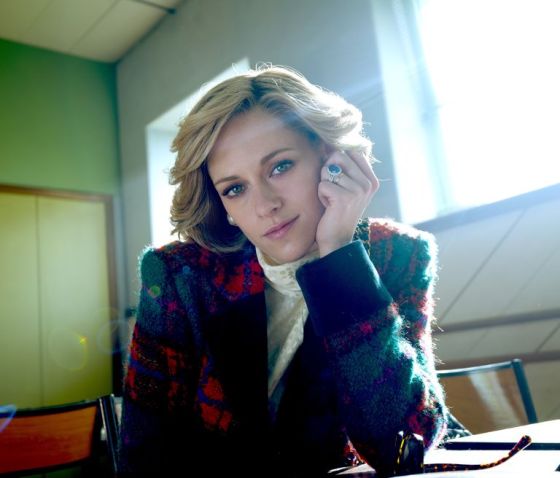
Courtesy of NeonKristen Stewart as Princess Diana in ‘Spencer’

But Diana is lost, in all ways. She stops at a small restaurant to ask for directions, and the locals gawk. Stewart-as-Diana blinks shyly, inclines her head, stammers politely—the complete Diana repertoire we know from photographs and news footage. In her tartan bouclé jacket, a Chanel bag slung over her shoulder, she’s anything but regular folk—yet she acts surprised when the locals recognize her patented charm routine. She eventually makes it to the estate, very, very late—she has arrived after the queen, an enormous faux pas, and it’s clear the whole family has their knives out for her, anyway.

The her-against-them dynamic is true to what we know from real life. But as Stewart plays Diana here—and as Larraín shapes the material—she’s so unpleasantly self-centered that you’re not sure she’d be a good guest at any Christmas. She’s late for every meal. She skulks about the house with her shoulders hitched to her ears, looking as if she’s about to pocket some of the royal silverware. She complains, endlessly, to herself and anyone who will listen—chiefly her deeply sympathetic maid, played by Sally Hawkins—that the family hates her and is trying to drive her crazy. In a nutso glamour montage, she swirls around the house and its environs in a series of silken gowns and chic daytime ensembles, the camera fluttering around her like a wounded swan. The staleness of her life hangs around her like an oppressive but very expensive perfume, and this whole movie is the commercial for it. Let’s call it Miss Dolor.

I know, I know: this isn’t a true-to-life movie about Princess Diana, it’s an interpretive dance about her gestalt, an Isadora Duncan-style leap into the satin-and-sadness psyche of a misunderstood and persecuted woman. Spencer strives to do for Diana what Jackie did for Jackie Kennedy—to build a feverish dream story around a woman wounded by real life. (Though Jackie is perhaps a worse movie—too arch by half.) I understand that in Spencer, when Anne Boleyn herself shows up at the royal Christmas Eve dinner, one unfortunate queen blinking a warning to a woman who might be headed for a similar fate, it’s not supposed to be real—it’s symbolic. But boy, is it dumb. When Diana sees this queen-ghost, she instinctively reaches for the strand of jumbo pearls around her neck—which, shot in Larraín’s patented technique of Obvi-o-Scope, represent a virtual beheading, especially given that we’re told Prince Charles had also given Camilla Parker Bowles the very same necklace. Diana, unloved, the recipient of a lousy gift from a clueless husband, is about to be discarded just as Anne was. She breaks the necklace right off her neck; the gumball-sized pearls spill into her soup, which she begins devouring ravenously, beads and all, in a hallucination of manic suffering.

Spencer
Courtesy of NeonKristen Stewart as Princess Diana in ‘Spencer’

Is this campy fun or inadvertent character assassination? It’s hard to say which. Larraín loves the breaking-the-pearls image so much that he recycles it later in the film, as if repeating it would somehow double its power. Meanwhile, Stewart gives her all, as she always does. But she plays Diana as a mannered doe—all wrong, given that does are the most unmannered creatures on Earth. Her performance is clearly stylized, but it’s also packed with calculation and guile. Larraín turns this Diana into exactly the thing the royal family accused the real-life Diana of being, a willful and pouty constant complainer. Stewart puts poignant quotation marks around every line—how could a director look at this nonsense in a monitor and think, Brava! (The intuitive mind-meld Stewart seems to have with French director Olivier Assayas is not in play here.) The Princess Diana of Spencer is a wronged innocent who seems sadly hooked on her victim status. It’s supposed to read as vulnerability, but it looks a lot like megalomania, surely the exact opposite of what Larraín intended. Maybe those of us who notice this are supposed to look the other way, coughing politely into our gloves. But with friends like these, Diana doesn’t need enemies.

 
Copyright 2009 Great Movies Database News. All rights reserved.
Free WordPress Themes Presented by EZwpthemes.
Bloggerized by Miss Dothy