RSS
Hello! Welcome to the Great Movies Database.

Today news: Shang-Chi and the Legend of the Ten Rings Made Me Feel Seen Like No Other Hollywood Blockbuster Has


It wasn’t a profound scene in Shang-Chi and the Legend of the Ten Rings that made me feel instantly connected to the film—not the Mandarin narration that opened the movie or even the early references to customs specific to Chinese culture like eating zhou, or congee, for breakfast and tomb-sweeping on the annual Qingming Festival. Of course, those storytelling choices told me that the latest Marvel superhero movie was crafted with viewers like me in mind. But it was a moment around 30 minutes in that let me know for certain I was watching my life experiences reflected on the big screen in a way Hollywood has rarely done: when Ronny Chieng’s character, Jon Jon, exclaims, “Wakao!”
[time-brightcove not-tgx=”true”]

This Mandarin word does not have a direct translation in English, though it could be likened to “damn.” It’s a term I grew up hearing in Taipei, Taiwan—where I spent the first 18 years of my life—and one I was told to use sparingly. I did not expect to hear it on the other side of the world, in a New York City theater, much less in a major production from Hollywood, whose projects centering Asian stories have been few and far between. As silly as it may seem, Jon Jon’s exclamation made me feel like I was in on an inside joke with the filmmakers.

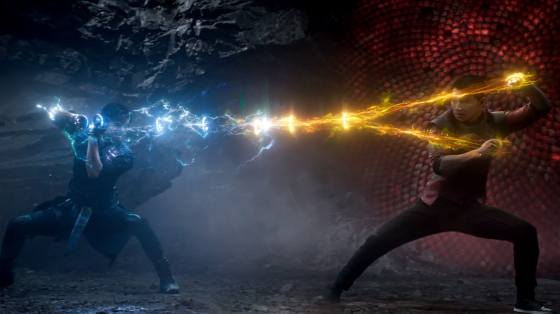
It was just one of many knowing moments I experienced throughout Marvel’s first Asian-led superhero film, out in theaters Sept. 3. Directed by Destin Daniel Cretton (Just Mercy), Shang-Chi follows the titular character, played by Simu Liu, who leaves an ordinary life as a valet parker in San Francisco to confront the family legacy built by his estranged father Wenwu (Tony Leung)—both the leader of the Ten Rings crime organization and the owner of the ten rings with supernatural power to which its name refers. Heading into the movie, I knew from teasers that it would celebrate Asian culture through martial arts-inspired fight sequences and a soundtrack featuring artists of diverse Asian descent including Jhené Aiko, Rich Brian and Niki. What I didn’t anticipate was that the movie’s distinctly Chinese details would connect me to Shang-Chi in a way I’ve not experienced with any other blockbuster made in Hollywood.

I’ve been thinking about why representation in entertainment matters so much to me, as someone who grew up in Asia where I was not part of a minority group. It’s partly because I experienced such a drastic shift from regularly seeing faces and stories like my own on the screen throughout my childhood and adolescence, to barely seeing any in the past eight years since I moved to the U.S.—just one of many reasons I find comfort in watching Korean dramas and Japanese anime now. Then there’s the fact that series and films produced in Hollywood were a large part of my media diet growing up. Yes, I watched Taiwanese dramas. But I also always had Cartoon Network and the Disney Channel on, devouring shows from Mandarin-dubbed versions of Dexter’s Laboratory and The Powerpuff Girls to The Suite Life of Zack & Cody.

As for the Marvel Cinematic Universe, its superheroes have been a significant part of Taiwan’s pop culture—Avengers: Endgame broke opening day records in 2019 before becoming Taiwan’s second highest-grossing film of all time after Avatar, and MCU-themed action figures are ubiquitous. My fellow student government members and I dressed up to reenact the 2012 Avengers trailer for a back-to-school video. All of which is to say, I’ve experienced first-hand how Hollywood’s influences spread far and wide, for good and for ill, and know that Marvel is introducing its first Asian superhero not just to the U.S. but the world. Which is why it meant even more to see parts of my identity reflected onscreen, in this genre where there has been a glaring absence of Asian characters.
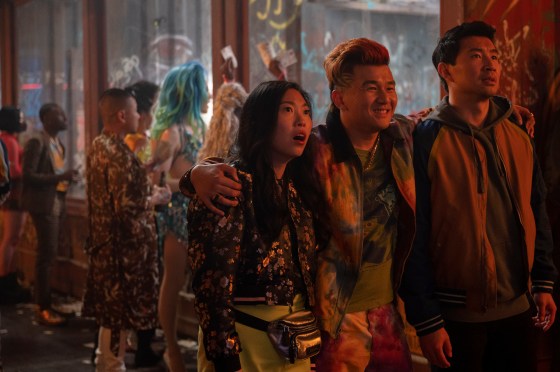
SHANG-CHI AND THE LEGEND OF THE TEN RINGS
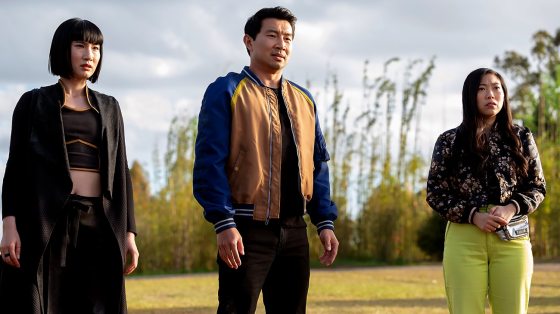
Jasin Boland—Marvel StudiosFrom left, Katy (Awkwafina), Jon Jon (Ronny Chieng) and Shang-Chi (Simu Liu) in Marvel Studios’ Shang-Chi and the Legend of the Ten Rings.

The film’s use of the Mandarin language, for starters, encompasses everything from slang to chengyu—idioms with roots in Chinese history that are primarily formed by four characters. In the opening scene, where Shang-Chi’s mother Jiang Li (Fala Chen) speaks of the origins of Wenwu and the ten rings, she describes him as having had the option to “cheng e yang shan” (懲惡揚善)—suppress evil and do good—but having chosen instead to use the weapon to conquer lands for his own gain. Hearing the expression brought me back to the classrooms of my Taiwanese elementary school, where memorizing pages upon pages of chengyu was part of the regular curriculum. And listening to a lengthy opening segment in Mandarin reminded me of hearing narrations of Chinese legends and tales while growing up, like when my brother and I crowded around the television to watch a cartoon adaptation of Xi You Ji, or Journey to the West, and savored every detail.

The film’s handling of Mandarin names also struck a chord, even in subtle instances, like when Shang-Chi calls his younger sister, Xialing (Meng’er Zhang), “Lingling” in a flashback scene. This small detail felt incredibly authentic, as nicknames in the Chinese community are commonly formed through doubling up on the final character. My full name is Meng Xiang Yue, and most of my extended family called me Yueyue throughout my childhood.

Then there are more obvious examples, as when Shang-Chi confesses to his best friend Katy (Awkwafina) that Shaun is not his actual name, but an alias he has used in the U.S. since leaving home. “Shang. Chi,” he enunciates slowly, repeating the first syllable after Katy, who does not speak Mandarin well, fails to get the sound right. He then spells it out in a last-ditch effort. The exchange made me recall all of my own attempts at teaching English-speaking friends how to say my Mandarin name during my years in the U.S. I am delighted when someone asks about this core part of my identity, but stumped when I try to answer. The truth is, there is no combination of English letters that would capture how to say many characters, including “Shang.” And that’s not even accounting for the tones—four pitched and one neutral—that accompany the characters. As someone accustomed to taking five or six attempts for the person I’m speaking with to reach 70% accuracy in pronouncing my name, Shang-Chi’s efforts felt deeply familiar.

One particular family interaction in Mandarin surprised me for how closely it reflected a common exchange in my life: When Jiang Li asks her children, Shang-Chi and Xialing, to go inside the house ahead of a pivotal confrontation. “I have to talk to the guests,” she tells them. In that moment, I knew the speech in this film was approached with care and intentionality. I can’t count the number of times the exact phrase in Mandarin, “wo gen ke ren you hua yao shuo” (“我跟客人有話要說”), was used by my parents when I was a kid. Especially in the presence of said guests, the line is code for: please leave the room, now.
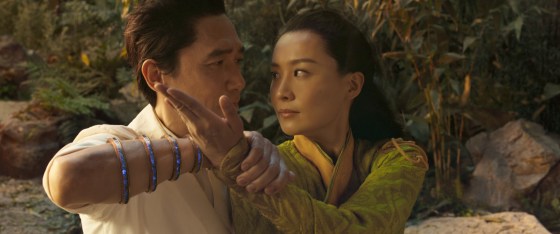
SHANG-CHI AND THE LEGEND OF THE TEN RINGS
Courtesy Marvel StudiosWenwu (Tony Leung, left) and Jiang Li (Fala Chen, right) in Marvel Studios’ Shang-Chi and the Legend of the Ten Rings.

That is not to say the language, and particularly the translation, isn’t without flaws. I chuckled at a signature Chinese liquor, baijiu, translated as “whiskey” in the subtitles, when the two are not the same. I raised an eyebrow at the aforementioned tomb-sweeping day, Qingming Festival, translated as “Day of the Dead”—which most commonly refers to the Mexican holiday Día de los Muertos. But despite these odd translations, I found the lines in my mother tongue to be thoughtfully infused with realistic expressions that helped create an intimate viewing experience.

Shang-Chi also impressed me with its portrayal of a family whose dynamics are rooted in values characteristic of Chinese culture. Most notably, the way in which Wenwu treats his son is the polar opposite of how he treats his daughter. Yes, the leader of the Ten Rings is harsh toward Shang-Chi—but at least they have a relationship. In contrast, a young Xialing watches her father beckon her brother toward martial arts training while she stands alone in the doorway. “Just nod. Don’t talk. He’ll forget you’re there,” Xialing tells Katy when they arrive in her childhood home. This is moments after her father, upon landing in the headquarters of his operation with both his children, announces, “My son is home. Take the girls to their room.”

The chengyu that sprang to my mind when viewing these interactions is zhong nan qing nü (重男輕女), which literally translates to “heavy male light female.” The saying refers to unequal treatment between genders and a patriarchal view of the world that has been prevalent in the history of Chinese society and through the teachings of scholars like Confucius. In the film, Xialing explains that Wenwu barely nods in her direction because he said she reminded him too much of her mother who is dead. This could be true, as a shot from a flashback shows the entire family, including Xialing, practicing martial arts forms together when Jiang Li was alive. But even with that reasoning, Wenwu’s dismissiveness toward his daughter is extreme. Given that the Ten Rings leader has lived for one thousand years (the rings offer immortality), his behavior can be at least partially explained by the traditional values that shaped him.

The zhong nan qing nü worldview has waned over time, and I thankfully grew up in a household where there was no major difference in how my younger brother and I were treated. But I see remnants of the bias in older generations of my family, with sons who have been favored and daughters often expected to support or follow rather than lead. That’s why I have a deep admiration for Xialing’s character, who refuses to stay in the shadows and takes up a weapon—a rope dart, to be exact—to train herself when there was no indication that Wenwu would. Being able to imagine the prejudice she faced, I cheered for Xialing all the more when she described the fight ring she had built, saying, “If my dad won’t let me into his empire, I’m going to build my own.”
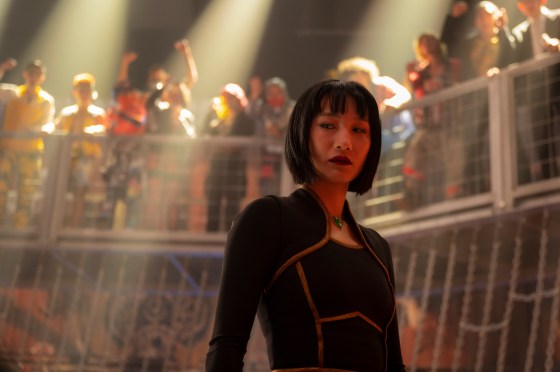
SHANG-CHI AND THE LEGEND OF THE TEN RINGS
Jasin Boland—Marvel StudiosXialing (Meng’er Zhang) in Marvel Studios’ Shang-Chi and the Legend of the Ten Rings.

In a recent Marvel featurette, Cretton said, “I wanted to look at what [a] superhero could be, what it would mean to me to be able to add not only one character, Shang-Chi, but to add a whole cornucopia of Asian faces that are representing something I’ve never seen before.” I can’t speak for how Asian viewers of other ethnicities will respond to the film—as it’s been said over and over again, the Asian American and Pacific Islander community is not a monolith. But as a Mandarin-speaking viewer who grew up in a home with Chinese values and traditions, I was moved by its efforts at portraying characters with experiences similar to my own. I also will have a different viewing experience from Asian Americans born and raised in the U.S. and from those who have lived in Asia for most of their lives.

But as someone with a bicultural, bilingual identity, it was refreshing to see the differences between the two experiences cleverly addressed with certain details. In one scene, Xialing, who lives in Macau, gives a measurement in meters and Katy, an American, responds, “What is that in feet”? In another, after Jon Jon, who also lives in Macau, speaks in Mandarin and Katy says she is not a fluent speaker, he switches to English and replies, “All good, I speak ABC.” The filmmakers don’t expand on the abbreviation, in another knowing wink to Asian American audiences who need no explanation on what it stands for: “American-born Chinese.”

In one of the shots of what appears to be Xialing’s childhood bedroom, a light pink graffiti-styled art piece on the wall reads wei xiao de mian ju (微笑的面具), which translates to “a mask for smiling” or “a smiling mask.” It’s a detail that, even if you read Mandarin, could be easily missed. The teaching of putting on a smile so as not to wear a sour look in public has been ingrained in me since I was a kid, and is intrinsic to the idea of saving face in Chinese culture. I am not the first to say that when it comes to representation, specificity creates authenticity. For me, it doesn’t get much more specific than small words in the background of a set bringing quick tears to my eyes as I recall myself as a girl, trying to hold them back.

Today news: How Shang-Chi and the Legend of the Ten Rings Reimagines Its Characters’ Racist Comic-Book Origins


It took 25 movies for Marvel Studios to produce its first Asian lead in a superhero film. In that time, fans protested the casting of Ben Kingsley as a character known as the Mandarin in Iron Man 3 as well as Tilda Swinton as the Ancient One, an Asian man in the comics, in Doctor Strange. And Asian characters like Randall Park’s Jimmy Woo, Benedict Wong’s Wong and Pom Klementieff’s Mantis have been relegated to supporting roles to white male heroes in movies like Ant-Man and the Wasp, Doctor Strange and Guardians of the Galaxy Vol. 2.

But Shang-Chi and the Legend of the Ten Rings, starring Simu Liu, finally hits cinemas on Friday, a coup for Asian representation in the most popular genre on the planet. It’s Marvel’s first movie directed by an Asian filmmaker, Destin Daniel Cretton. It’s also only the fourth film produced by a major Hollywood studio to feature a predominantly Asian cast, along with The Joy Luck Club, Crazy Rich Asians and last summer’s Mulan. But Shang-Chi wasn’t always an obvious barrier breaker. The character’s origin in the comics was mired in racist stereotypes. Most notably, his father in the original comics, Fu Manchu, was a caricature of a power-hungry, mystical Asian man.
[time-brightcove not-tgx=”true”]

Rethinking Shang-Chi’s father

Marvel StudiosTony Leung and Simu Liu in Shang-Chi and the Legend of the Ten Rings

The villain in Shang-Chi is the titular character’s father, Wenwu (Tony Leung), the leader of a criminal organization who wields—you guessed it—ten rings that imbue him with power.

Wenwu is part new invention, part a combination of several different Marvel characters from the comics. Though you can see little trace of him in the movie, Shang-Chi’s father in the comics is actually Fu Man Chu, a villainous character from literature, rooted in racism and stereotypes, that Marvel licensed in 1973.

In the 1910s, novelist Sax Rohmer, the story goes, consulted a Ouija board in order to come up with the character who would make his fortune. The answer came back letter by letter on the board: “Chinaman.” Not an auspicious start.

Rohmer went on to write a series of books about a mystic named Dr. Fu Manchu. The character was an avaricious Asian man, his one ambition in life to conquer the West. He had long curved fingernails, inhuman yellow skin and the long, thin mustache that would come to be named after him. Rohmer described him as “yellow peril incarnate.”

Fu Manchu became one of the most popular villains of the 20th century. He was recreated in TV, radio and film. Even Nicholas Cage played a version of him in Grindhouse. In the 1970s, Marvel tried to capitalize on the popularity of martial arts first by trying and failing to acquire the rights to adapt the popular David Carradine TV series Kung Fu and then by licensing Fu Manchu. They decided to give him a son, a new hero to take on the notorious villain: Shang-Chi.

The reclamation of Shang-Chi

Marvel Studios Meng’er Zhang, Simu Liu and Awkwafina in Shang-Chi and the Legend of the Ten Rings

Shang-Chi made his debut in Steve Englehart and Jim Starlin’s Special Marvel Edition no. 15 in 1973 and became the lead in his own comic series, Master of Kung Fu. But the arc relied more heavily on its villain, Fu Manchu, than its hero. It became clear that the character existed to awe white audiences with his martial arts feats, and when Kung Fu fell out of fashion in American culture, so did the character. Marvel discontinued the comic in 1983.

In the last year, Marvel has relaunched the Shang-Chi comic under the stewardship of Eisner-award-winning writer Gene Luen Yang, who has endeavored to, for starters, imbue Shang-Chi with an actual personality.

Similarly, Cretton and his team pitched Marvel Studios a story about family drama that just happened to also feature Kung Fu. They pulled the most compelling aspect of the original Shang-Chi comic—the conflict between father and son—but humanized both the hero and the villain, rather than othering them as the comics had done.

But the movie had to contend not only with a history of racism in the comics, but a history of stereotyping in the Marvel Cinematic Universe itself.

Retconning the Mandarin and the Ten Rings organization

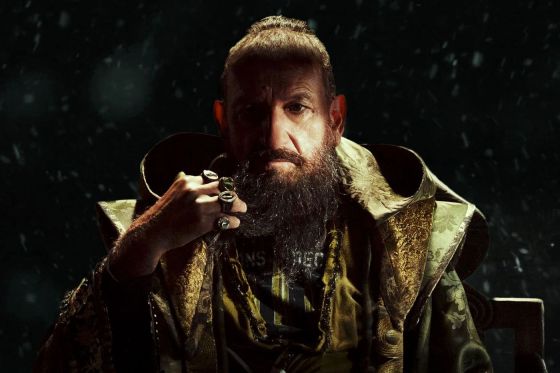
Marvel StudiosBen Kingsley in Iron Man 3

MCU fans may remember the Ten Rings from the very first Marvel Studios movie, Iron Man, as the terrorist organization that kidnaps Tony Stark and goads him into building the very first Iron Man prototype in order to escape. While imprisoned by the Ten Rings, Stark discovers that the group is buying Stark technology off the black market and vows to change his ways. Stark returns to the desert where he was held captive and kills the terrorists responsible, but his ultimate confrontation is with his business partner Obadaiah Stane (Jeff Bridges) who it turns out was selling Stark weapons to terrorists.

The Ten Rings mostly disappear from the MCU after that point—Stark never seems compelled to discover the head of the organization that nearly killed him. In Shang-Chi, we find out that Wenwu is in fact the man in charge of the Ten Rings, an organization that earned its name from his powerful ten rings.

At one point in the movie, Wenwu explains away another MCU misstep, the casting of Ben Kingsley as the villain The Mandarin. The Mandarin made his Marvel comics debut in 1964 as an Asian supervillain and archenemy of Iron Man. The Mandarin loomed large over Iron Man 3. In that film, in videos publicized to the world, a man (played by Kingsley) who calls himself the Mandarin threatens Tony Stark. But when Stark eventually finds and confronts his supposed foe, he discovers that the man is nothing but an actor named Trevor Slattery hired to play a terrorist, a distraction from the true baddie of the film, Aldrich Killian (Guy Pearce), a scientist once spurned by Stark who wants revenge.

In Shang-Chi, Kingsley’s Slattery makes a brief cameo, imprisoned by the Ten Rings organization that he once mocked. Later, Wenwu quickly dismisses Aldrich Killian’s bizarre decision to hire a white man to impersonate Wenwu using an Asian name. “He didn’t know my actual name. He invented a new one,” Wenwu says. “He gave me the name of a chicken dish. It worked. America was afraid of an orange.”

Today news: Oscar Isaac Smolders in the Pensive Romantic Thriller The Card Counter


Oscar Isaac, the star of writer-director Paul Schrader’s ardent romantic drama The Card Counter—premiering at the 78th annual Venice Film Festival—is the matinee idol we barely deserve in our short-attention-span world, an era when we barely allow ourselves time to read a face or lose ourselves in a pair of eyes. Yet as soldier-turned-poker-ace William Tell—the finest, silliest pseudonym a fictional poker player has ever chosen for himself, hands down—Isaac demands that we slow down and look. His just-graying hair says, “Don’t wait until tomorrow.” His conscientious-basset-hound eyes say, “Don’t get stuck in yesterday.” He sets the pace for The Card Counter, which is what you might call a pensive fairytale, a story about guilt that can be burned away only with the benediction of love.
[time-brightcove not-tgx=”true”]

That’s a lot of weight for a movie to hold, but if anyone can pull it off, it’s Schrader—not only the writer of Taxi Driver, but the mad brain behind pictures like Patty Hearst, The Comfort of Strangers and First Reformed, movies that command acute attention but give a great deal in return. Schrader’s career has been long, and dotted with highly imperfect pictures. But even a not-great Schrader picture is still more interesting than some movies made by young, so-called geniuses. And The Card Counter, intense and vital and hugely satisfying, is pretty great.

In an early voice-over narration, Isaac’s William Tell explains that he’s done a stint at Leavenworth for a crime he doesn’t immediately describe. All we know is that he kind of liked prison, where he finally got into the routine of reading (“I’d never read a book before. Not all the way through”) and learned another life skill as well: how to count cards. When he’s done with prison, he travels around playing poker for a living, paying cash to flop in cheap motels, whose rooms he immediately redecorates in a manner specific to his liking—it’s best that you see this for yourself. And in these motel beds, he suffers nightmares, hellish visions of torture at Abu Ghraib. William, we learn, was on the side of the torturers, having been trained by a contractor who knew the most evil ways to extract information, Willem Dafoe’s wily, weaselly Major John Gordo. William’s guilt seems to buzz in his head like a low-grade hum, neither dissipating nor rising to the surface, where he might be able to deal with it. Instead, he just keeps playing cards, winning modestly to maintain a low profile.

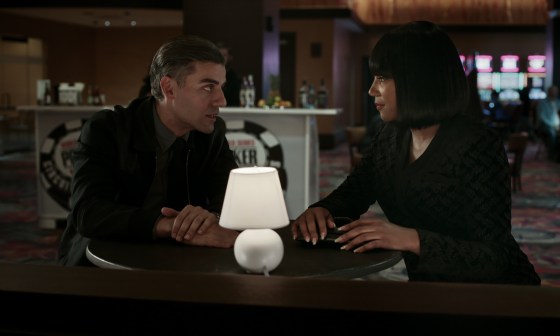
Oscar Isaac as William Tell and Tiffany Haddish as La Linda in The Card Counter.
Focus FeaturesOscar Isaac as William Tell and Tiffany Haddish as La Linda in The Card Counter.

Then he meets a dazzling young woman: she comes at him in sections, a little like Cyd Charisse angling toward Fred Astaire in The Band Wagon. She goes by the name La Linda, and she’s played by Tiffany Haddish, a cool, funny bombshell—though her earnest, eager face also makes her deeply touching. La Linda wants William to join her “stable,” playing poker for a group of anonymous backers. Around the same time William meets La Linda, he encounters a lost kid—that his name is pronounced Kirk but spelled Cirk with a c is just the beginning of his problems. (He’s played, with sly prevarication, by Tye Sheridan.) William sees the hopelessness of Cirk’s path, and decides to help. Cirk has some debts; if William plays enough poker, he can toss some dough Cirk’s way. He agrees to join La Linda’s stable for just that reason.

By now, everyone who’s ever seen a Paul Schrader movie knows that he favors deep moral explorations, and often writes characters who are obsessed with routines and rituals, ascetics for better or worse. William Tell is one of those characters. What we see less often is Schrader’s romantic streak, visible in movies like the terrific (and little-seen) 1999 romantic melodrama Forever Mine, with Joseph Fiennes and Gretchen Mol. The Card Counter is billed as a thriller, but the love story that shimmers to life, slowly, between William and La Linda is one of its greatest strengths. As these two walk through a park lit by endless strands of colored lights, not yet a couple but getting there, the electricity between them is its own kind of color, an invisible paintbox of attraction. The point isn’t that love can save the troubled hero; it’s that he must save himself in order to feel its grace. Counting cards is much, much easier.

Read more reviews by Stephanie Zacharek

The Card Counter is both unsparing and deeply romantic, the kind of picture we don’t see every day, even at a time when new movies seem to pour into our streaming queues, if not our theaters, at an alarming rate. If nothing else, it’s an entreaty to hold out for quality, for pictures made with thought and care—why go for farmed salmon when you can have the wild? The Card Counter, with Isaac’s superb performance at its heart, might be the movie you didn’t know you were wishing for, coming at a time when wishing for life to restart has become a consuming preoccupation.

Today news: Jane Campion’s Gorgeous Western The Power of the Dog Is a Sharp Study of Masculinity Gone Awry


If you’re going to borrow, borrow from the best. Jane Campion begins and ends her sinewy western The Power of the Dog with a nod to John Ford’s penchant for framing figures and action through doorways and windows, less a way of focusing our gaze than a proclamation: This is cinema, people—use the whole canvas! After an enforced year or so of watching movies on tiny screens, it’s a pleasure to sink into Campion’s smart, entertaining and terrifically tense sand-painting of a picture, premiering at the 78th annual Venice Film Festival.

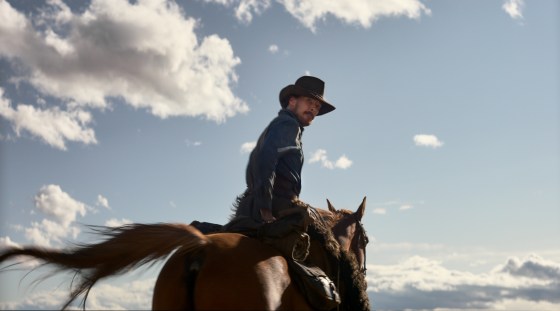
Based on Thomas Savage’s 1967 novel of sibling strife in 1920s Montana, The Power of the Dog stars Benedict Cumberbatch and Jesse Plemons as, respectively, Phil and George Burbank, rancher brothers whose disparate personalities could be summed up in a single sentence: One bathes, the other doesn’t. George, the bather, is tidy and polite, given to wearing Sunday-best suits and ties as he goes about his rancher business. Phil is the rebel, snarling in cruddy chaps; knife in hand, he can castrate a bull with a flick of the wrist. When George falls in love with and marries Rose (Kirsten Dunst), the widowed proprietress of a desolate hotel, Phil seethes with a roiling crock full of emotions—resentment, jealousy, disdain—that find their way out through Cumberbatch’s pinched, appraising eyes. He assesses the world and finds it contemptible.
[time-brightcove not-tgx=”true”]

But Phil really takes a dislike to Rose’s slim-as-a-reed son, Peter (Kodi Smit-McPhee), a sensitive, dreamy lad who likes to make paper flowers and accepts his mother’s doting attention freely. Phil immediately spots Peter as being way too soft, a sissy boy, and hazes him ruthlessly. We come to learn that Phil idolizes a long-gone horseman named Bronco Henry, a mythic figure who taught Phil everything he knows about riding horses, and other things. Phil’s notions of what a real man ought to be are both rigid and wrong-headed, and he inflicts them on those around him like snake venom.

power-of-the-dog-benedict-Cumberbatch
Kristy Griffin/Netflix Benedict Cumberbatch as Phil in ‘The Power of the Dog’

If your latent-homosexuality alert hasn’t gone off yet, it may be time to calibrate the settings. Yet nothing in The Power of the Dog goes quite as you expect. If Phil is cruel, his intelligence is off the charts—and even he is capable of succumbing to enchantment. Campion—in her first feature since the velvety-gorgeous 2009 romance Bright Star—navigates the story’s tricky shifts with ease, and the performances are uniformly fine. Dunst’s Rose, in particular, is a careworn marvel, a fragile beauty who knows the years ahead won’t be kind to her: she’s perched at the tipping point between cherub and matron.

Read more reviews by Stephanie Zacharek

The Power of the Dog works as a western, a thriller, a psychological study of masculinity gone awry. Best of all, Campion and her cinematographer, Ari Wegner, use the expanse of screen they’ve been given as if it were a precious resource, making the most of a purple-velour mountain backdrop or the interior of the Burbanks’ large but airless house, a stifling arena of melancholy mahogany furniture and Persian rugs topped with gratuitous bearskins. This is a movie as big as the open sky, but one where human emotions are still distinctly visible, as fine and sharp as a blade of grass.

Today news: Why Nun Stories Are About to Become Your Next Pop-Culture Obsession


Movie stars, courtesans, spies, nuns: the aura of feminine mystery burns strong in all of them, but nuns may be the most enigmatic of all. Unless you’re among their ranks—and maybe even then—you can never really know them.

When I was a Catholic school kid in the late 1960s and early ’70s, many of my teachers were joyful Franciscans, not the crabby, knuckle-rapping ones of earlier decades. These were nuns who strummed their guitars at folk mass, their billowy black garments swinging in tune, who played basketball with us, switching out their dainty oxfords for Chuck Taylors. One had grown up on a farm, and when a cow at home gave birth to a two-headed calf, she had her brother send the dual heads, by then stuffed, to our school in a big wooden box. We filed past solemnly, unsure if we were gazing upon a miracle or a mistake.

[time-brightcove not-tgx=”true”]

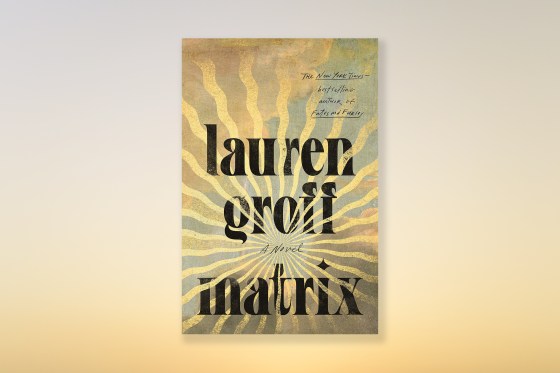
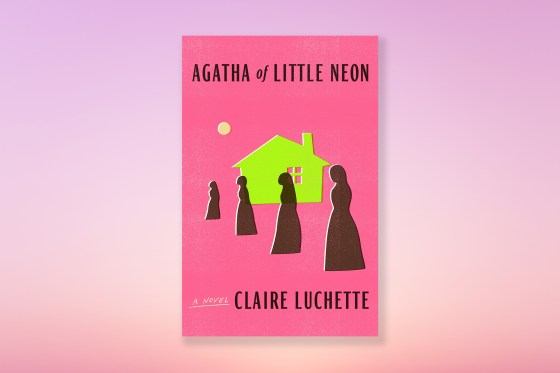
The sisters were often fun and always kind. Yet we knew so little about them. What draws a woman to this type of sisterhood? And are their friendships and rivalries so different from our own? Two new novels, Lauren Groff’s Matrix, coming Sept. 7, and Claire Luchette’s Agatha of Little Neon, which arrived in August, peek behind the veil to surmise what nuns might be thinking about when no one but God is listening in—and provide a glimpse into the doubts and changes of heart that sometimes turn these brides of Christ into divorcees.

Nuns are hot this season: cinema provocateur Paul Verhoeven’s soon-to-be released Benedetta tells the—true!—story of a lesbian nun in early 17th-century Italy, a sister who experienced wild religious visions but who also used her status as a mystic to coerce a fellow nun into sexual relations. As Judith C. Brown relates in her 1986 study Immodest Acts: The Life of a Lesbian Nun in Renaissance Italy—which Verhoeven used as a source—Sister Benedetta Carlini lured her fellow sister into sin by claiming that the poor girl was actually having sex with an angel named Splenditello, who had morphed into Benedetta’s form. As deceitful come-ons go, you’ve got to admit that’s ingenious.

Matrix—Groff’s first novel since her 2015 hit Fates and Furies—imagines the story of a nun who was temperamentally very different from Benedetta but also a real-life figure, the 12th-century poet Marie de France. Not much is known about the real Marie, but she left behind a series of short narrative poems known as the Lais of Marie de France, and Groff creates a rich backstory for her, as detailed as a unicorn tapestry. She introduces us to Marie, age 17 in 1158, born in France but living in England in the court of Eleanor of Aquitaine, the French-born wife of Henry II. The queen is sending Marie—an ungainly girl with large bones, and an illegitimate Plantagenet child to boot—to a far-off and troubled abbey, where Marie will become prioress. Simmering with anger and frustration, Marie is packed off to the dank, depressing convent, a place of famine, starvation and nuns who are not altogether welcoming. Her exile is particularly stinging because she’s long been in love with Queen Eleanor.

But the young woman is smart and ambitious, and before long, she has climbed the convent ranks to reach the vaunted status of abbess. She fills the abbey’s coffers by managing its land more intelligently, ensuring that neither her nuns nor the inhabitants of the abbey’s satellite communities go hungry. She hatches and fulfills brilliant if mildly arrogant plans, like building a maze around the convent as a means of isolating it and thus protecting it from evildoers. And she writes poems—the verses that will become the lais we know today—based on her extravagant religious visions. In Groff’s imagining, Marie—like the nun Benedetta, who will be born centuries later—also wrestles with her own desire, though her urges take a far less sinister form. In one of the novel’s jauntier passages, a cheerful healer among the nuns named Nest discreetly relieves Marie of some pent-up sexual energy. She calls it “an expression of the humors,” and reveals, to Marie’s surprise, that it’s a health service she supplies to any of the sisters who might need it.

If you come to Matrix looking for hot nun action, that’s about as hot as you’re going to get. This is really a novel of sisterhood, of women finding clever routes to claiming their power, given all the roadblocks men have historically thrown up before them. Groff’s prose is sometimes elegant and sometimes willfully serpentine, curving around in overly complicated loops. One example of the latter: “Because the deep heat is stirring again, unquelled; the devouring fire of the curse of Eve as it leaves this body beginning to pulse from inside out to the skin.” That’s Marie, at the onset of menopause, experiencing a wordy hot flash.

But Groff’s book achieves liftoff here and there, especially in the way she sketches the personalities of Marie’s fellow nuns, chiefly Sister Gytha, “who sees fairies zipping about on birdwings and her own mother’s face in the moon.” Sister Gytha can’t read or write, but she can make splendid drawings, so Marie puts her to work in the convent’s newly instituted scriptorium, where she adorns manuscripts with all manner of vividly colored beasties. The next time you marvel over a weird medieval illumination—a cat playing a trumpet through its butt, or somesuch—just chalk it up to Sister Gytha.

Luchette’s Agatha of Little Neon—set not in the Middle Ages but in the recent present, circa 2005, in Buffalo, N.Y., and Woonsocket, R.I.—is the livelier, funnier of these two books, and is ultimately the more moving for it. The Sister Agatha of the title, the story’s narrator, is a shy and rather awkward woman, on the cusp of 30, who never really knows what to say or how to say it. Her mother died when she was 11; as a teenager, she wished she could melt into the background. Just out of school, she took a job at a gas station. She was drawn to her vocation not by hearing the call of God, but by watching two nuns trying on heart-shaped, Lolita-style sunglasses, joking and laughing, as they stopped for a fill. “There was no invitation. There was only that night in the gas station: it was late, and I was lonely, and I understood, watching the two nuns, that you could live your whole life alone if you weren’t careful. You might never find a decent place to hide from yourself.”

Agatha finds that place to hide, but also a sense of joy, with three fellow sisters and the elderly Mother Roberta, a no-nonsense spiritual guide and advice-giver whom Agatha adores. But Mother Roberta has decided to retire. And because of budget cuts, the four sisters are sent away from their Lackawanna convent and reassigned to run a halfway house in Rhode Island. It’s called Little Neon because it has been painted a distinctive bright green—the color, Agatha notes, of Mountain Dew—as the paint had been bought on clearance.

Agatha loves her sisters. They work, pray and crack jokes together. With their extremely limited funds, they buy sanitary napkins in bulk and snap up pantyhose on sale when they find them—sisters are women, after all. When Agatha is recruited to teach geometry at a nearby school, she’s at first terrified, fearful of being wrenched away from her family of sisters, and from the daily routine of Little Neon and its cast of wonderful, if troubled, characters. But teaching also opens her to a life of the self that she hadn’t acknowledged before. What’s more, she sees how the Catholic Church itself, in its vile, years-long denial of sexual-abuse allegations, has betrayed her. Agatha of Little Neon is a novel of self-discovery and of faith—or, more specifically, the unmoored feeling of suffering a crisis of faith.

But then, there is no faith without doubt. Questions don’t destroy faith; they’re the rain that keeps it alive. What does it mean to choose to become a Bride of Christ, only to realize you’re a lousy wife? Perhaps the answer comes back to knowing yourself as a woman first, and each woman is her own mystery. Movie star, courtesan, spy or nun, we all bleed the same.

Today news: Penélope Cruz Gives One of the Best Performances of Her Career in Pedro Almodóvar’s Parallel Mothers


History is the work of mothers—civilization can’t move forward without them. That’s the rushing undercurrent of Pedro Almodóvar’s eloquent and subtly affecting new film Parallel Mothers (Madres paralelas), the opening film of the 78th annual Venice Film Festival. Penélope Cruz plays Janis, a professional photographer in her late thirties whose relationship with a married forensic anthropologist, Arturo (Israel Elejalde), results in pregnancy. In the maternity ward, she befriends another mother-to-be, Ana (Milena Smit), a teenager whose child was conceived under very different circumstances. Both give birth on the same day, to girls, and in the time just before and immediately after delivery they trade confidences, helping each other through this strange period of transition as the welcome these instantly beloved little strangers into their lives.
[time-brightcove not-tgx=”true”]

The story Almodovar tells involves one shocking discovery and the keeping of secrets, as well as the way motherhood can bring women together, only to lead them down different paths—in that way, it provides plenty of opportunity for the melodramatic flourishes this 71-year-old filmmaker loves so well. But with his 23rd film, Almodóvar continues to tap the contemplative vein of his last feature, 2019’s superb Pain & Glory, a semiautobiographical exploration of aging and mortality. This time, he’s also delving more directly than usual into the pain of his country’s past. Even before her baby is born, Janis, who lives in Madrid, is consumed with one goal: to open a mass grave in her home village, containing the body of her great-grandfather and several of his compatriots, murdered in the Spanish Civil War and never properly mourned or honored. Somehow, Almodóvar teases two entwining tendrils into one graceful vine, a reflection on the way babies, even as they point the way to the future, connect us—with their inherited smiles, the DNA sparkle in their eyes—with the lives of those who came before.

Read more: Pedro Almodóvar’s Vibrant Pain and Glory Makes the Heart Pump Harder

Parallel Mothers
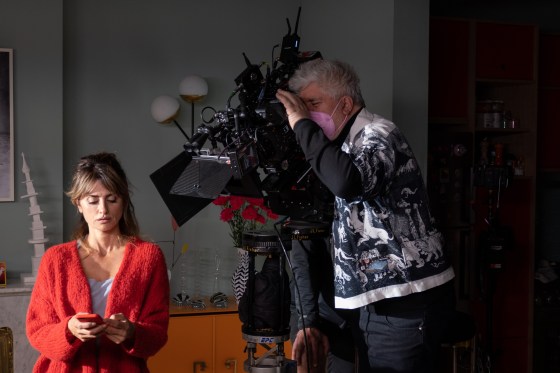
El Deseo D.A. S.L.U., photo by Iglesias Mas. Courtesy of Sony Pictures Classics.Penélope Cruz and Pedro Almodóvar filming ‘Parallel Mothers’

Parallel Mothers is a movie of infinite tenderness, that rare ode to motherhood that acknowledges mothers as women first and mothers second. Women are Almodóvar’s world, and the movie worlds he writes for them are rich and affectionate, too. In an early scene, as this duo of moms get ready to push their babies out into the world, their respective coaches—with neither of the fathers in the picture—show up in a double flurry: Ana’s mother, Teresa (Aitana Sánchez-Gijón), a self-involved actress, sweeps into the room in a supple camel-colored coat made more for a Hitchcock heroine than a birthing-room helper. Meanwhile, Janis’ closest friend, magazine editor Elena—played by the wonderful Almodóvar veteran Rossy de Palma, whose marvelous schnozz is one of the grandest in movie history—arrives in a riot of multicolored plaid, ready to welcome baby into a polychrome galaxy of love.

The contrast between these two helpers is a witty touch, and just one example of the way Almodóvar enlists the power of color and costuming in everything he does—though it’s worth noting that he ultimately allows Teresa, even within her bubble of selfishness, to emerge as a complicated, fragile human. There are no villains in Parallel Mothers, beyond political ones: Almodóvar is interested in extreme drama, with its inherent joy and emotional turmoil, but he also makes room for forgiveness. There is no future without it.

And with these two lead roles, he gives newcomer Smit and certified movie star Cruz an unqualified gift. The friendship between Janis and Ana is at times frayed but ultimately forges itself into something stronger than sisterhood, and Smit and Cruz carry us deftly through its evolution. When we first meet Smit’s Ana, she’s practically a schoolgirl, a confused innocent who, with her swollen belly, has no idea what’s in store for her. Later, her life forced into a new shape by tragedy, she emerges as her own woman, a warrior queen with a bleached pixie ’do. Smit, her eyes both resolute and soft, segues from girl to woman in a single, believable heartbeat.

Read more reviews by Stephanie Zacharek

Cruz has long been one of Almodóvar’s signature actors, a dazzling, witty presence in movies like All About My Mother and Volver. These two understand each other completely; it seems she’s able to follow the sometimes squirrelly crumb trails of his thinking without missing a step. Cruz is astonishing here, in what may be the best performance of her career so far. Janis’ fragility and her fortitude are two sides of one coin, and Cruz can shift from one to the other in the merest breath. Just as Janis believes she has everything she wanted and never thought she’d get—she has at last become a mother, after thinking it would never happen—she’s faced with a new trial, and the possibility of loss.

Because only in the movies are people’s problems solved by a single event. In real life, most solutions also open the door to at least one problem—and yet through those same doors, blessings also walk through. Cruz plays Janis as a woman who learns to stop watching that door and instead simply welcome whatever comes next. To reach that point, she must also reckon with the way her own past—her ancestry, and thus that of her child—dovetails with the sometimes painful history of her country. Cruz folds all of that complexity into this performance. With a blink of her Cleopatra eyes, she sends Almodóvar’s Morse Code message of love out into the world. Anybody who’s open to the lingo can understand.

 
Copyright 2009 Great Movies Database News. All rights reserved.
Free WordPress Themes Presented by EZwpthemes.
Bloggerized by Miss Dothy