RSS
Hello! Welcome to the Great Movies Database.

New story in Entertainment from Time: Sure, Netflix Christmas Movies Are Often Patently Absurd. They’re Also Occasionally Perfect


It’s official: our brains are fried. The holiday season is stressful enough in normal times. But this year, what we wouldn’t give to have that normal level of present-buying, cookie-baking, tree-decorating stress, instead of all this 2020-specific heartache, anxiety and exhaustion. It’s enough to make you want to line up a bunch of Netflix Christmas movies and gaze upon them, one after another, with reckless disregard for alleged quality or degree of believability. In fact, the less realistic, the better. A Chicago cupcake baker—who bears an uncanny resemblance to the duchess of a phony European nation—falling in love with a prince? Calgon, take me away.

By no means does Netflix have a monopoly on the brain-candy Christmas movie; these have been Lifetime and Hallmark Channel staples for years, and it’s likely that even people you’d never suspect harbor a secret favorite or two. (Hallmark’s The Nine Lives of Christmas, from 2014, involves cats and a fireman played by Brandon Routh. Probably only about eight people have seen that one.) But Netflix, in addition to flooding the market with original movies, makes it numbingly simple to watch one of these films after another, with barely a flick at your trackpad. You can stack up Holidate (an unsentimental Emma Roberts lines up Australian hottie Luke Bracey as a boyfriend for holidays only), Jingle Jangle: A Christmas Journey (a lively, if overlong, musical fantasy about an eccentric toy inventor played by Forrest Whitaker) and The Princess Switch: Switched Again—a sequel to the 2018 sensation featuring Vanessa Hudgens as the aforementioned duchess-doppelganger baker—all without having to leave the bathtub, unless you need to refill your wine glass. Once you’ve jetted through those, you can shimmy over to Alien Xmas, The Christmas Chronicles: Part Two, or any number of Christmas-themed offerings from earlier years. You could always just watch A Christmas Prince—or either of its two sequels—again.

Read more: The Best Christmas Rom-Coms of 2019

I know what you’re going to ask next: Aren’t these movies bad? Shouldn’t I be embarrassed about watching them? My answer to the second question is no, because how we respond emotionally to visual information is not an arena for shame or judgment. Does that mean that there are more beautifully made and wonderfully acted Christmas movies beyond these? Of course. I would not trade Ernst Lubitsch’s 1940 Shop Around the Corner—for my money the most beautiful, bittersweet holiday romance—for the lot of them.

But then, because of that film’s rare beauty, I don’t expect many other films to measure up, and that sense of discernment is freeing, not restrictive. When you watch movies for a living, people often ask if you can turn your my brain and just watch a movie for fun. The general answer is no, because for me, thinking and watching simultaneously is fun. But thinking can be multihued. It’s possible to give yourself over to a movie even when it’s written in lingo you’ve seen many times before—to note how pretty a castle looks when it’s surrounded by snowy trees, to admire a fairy-tale character’s colorful wool coat, to succumb to the unsurprising surprise of two allegedly mismatched characters bumping into each other beneath the mistletoe—without scolding yourself for what gives you pleasure. The line between a cliché and a cherished convention is often so slim it’s almost undetectable.
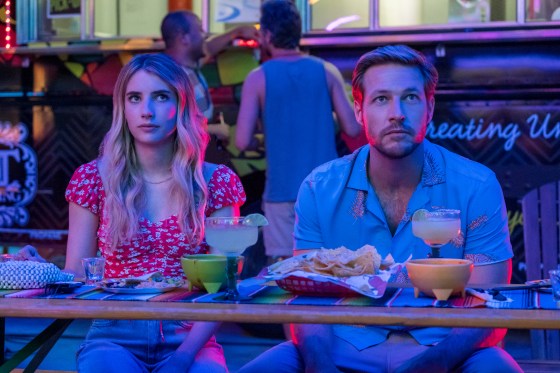
HOLIDATE (2020)Emma Roberts as Sloane Reed and Luke Bracey as Jackson. Cr. Steve Dietl/NETFLIX
Steve Dietl/NETFLIXEmma Roberts and Luke Bracey play dates with restrictions in ‘Holidate’

So what awaits you in the Christmas 2020 Netflix queue? Holidate works too hard at being raunchy, but I happen to have a soft spot for Emma Roberts and her resolute eyebrows. Plus, you’ve got Luke Bracey as a ridiculously good-looking manly-man golf pro with a surprisingly sensitive side. You may as well be eating ice cream right out of the carton. Jingle Jangle—a holiday fantasy aimed at kids, but not bad for adults—is quietly radical in its mostly Black cast. It’s a switch from the norm that underscores how misguided those norms are in the first place. Plus, the costumes (by Michael Wilkinson) are a delight, a riot of Victorian and steampunk silhouettes rendered in traditional Kente cloth and African wax prints.
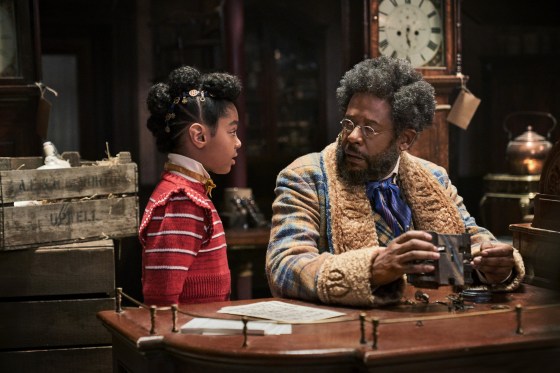
JINGLE JANGLE: A CHRISTMAS JOURNEY (2020)Madalen Mills as Journey Jangle and Forest Whitaker as Jeronicus Jangle. Cr.Gareth Gatrell/NETFLIX
Gareth Gatrell/NETFLIXMadalen Mills as Journey Jangle and Forest Whitaker as Jeronicus Jangle in ‘Jingle Jangle: A Christmas Journey’

But for pure candy-box escapism, the prize goes to The Princess Switch movies, with Vanessa Hudgens playing at least two different versions of Vanessa Hudgens. In the first Princess Switch, she’s the perky Chicago baker, Stacy De Novo, who, while attending a baking competition in the picturesquely phony European nation of Belgravia, discovers that she’s a dead ringer for svelte and elegant Lady Margaret, a royal denizen of the nearby and equally phony European nation known as Montenaro. Lady Margaret is engaged to be married to the Prince of Belgravia, the kind but seemingly bland Edward (Sam Palladio). Unfortunately, she’s just not that into him. Meanwhile, Stacy’s best friend and business partner, the totally hot and adorable Kevin (Nick Sagar), has a crush on her that’s been unrequited for years; Stacy loves Kevin platonically, but doesn’t feel any sparks. Margaret, bound by her royal duties, longs for more spontaneity; Stacy wouldn’t mind being a fancy royal for a day or so. And so the two switch identities, only to discover that one woman’s rejected beau is the other’s dream match. The movie ends with one royal wedding and a hint at a future engagement. Everybody goes home happy.

In The Princess Switch: Switched Again, Lady Margaret is about to be crowned Queen of Montenaro. Sadly, her acquiescence to royal duty has broken up her romance with Kevin (though you know that’s not going to stick). Enter Margaret’s bad gal cousin Fiona (played by—surprise!—Hudgens again), a party girl with a peroxide tumble of tresses, who favors tacky clubwear and faux furs in tones not found in nature. Fiona hatches a scheme to impersonate Margaret and thus become Montenaro’s monarch. Chaos ensues, though romance prevails.
Vanessa Hudgens and Vanessa Hudgens in 'The Princess Switched: Switched Again'
NetflixVanessa Hudgens and Vanessa Hudgens in ‘The Princess Switched: Switched Again’

If nothing else, how can you not love the idea of fictional countries with names that sound borrowed from 1960s sportswear companies? The Princess Switch and its followup are so indefensibly enjoyable they need no defense. Recently, over socially distanced lunch with a friend, I found myself regaling him with a highly animated summary of the first movie’s plot. “Oh. It’s Shakespeare,” he said, between bites of sandwich. (It’s also a device Mark Twain put to use in The Prince and the Pauper.) Stories of swapped identities, of one character being mistaken for another and causing mischief, or falling in love, are nothing new, and they were invented by people with good instincts for what human beings like. Our consistencies unite us across eras.

If you were to break the Princess Switch movies down to their barest elements, they could almost be performance art—big squares, circles and triangles that speak in ways that defy words. These are movies written in flag language, semaphore that can be read clearly from a great distance. Switched Again ends with (spoiler alert), a wedding, a reconciliation and a coronation, all of which tap out a code that our wilted minds receive gratefully. We may think our brains aren’t working, but they are; they’re experts in the art of the busman’s holiday. Love, forgiveness, the beauty of a sparkly gown: These are oversized signals, easy to read and comprehend from a great distance, reaching out to us as we watch from our respective isolated islands, or bathtubs. If they were good enough for the Elizabethans, they’re good enough for us.

New story in Entertainment from Time: Wonder Woman 1984 Arrives When We Need Some Fun—But It Could Have Been More Than That


Wonder Woman 1984 isn’t great and it isn’t terrible. It’s a movie that has simply arrived at a time when people need a diversion, and following a summer devoid of blockbusters. Everybody could use some fun, and the studio behind the film, Warner Bros., has made the responsible decision to release it in U.S. theaters and on HBO Max on the same day, Dec. 25. Even if it’s not nearly as much fun to watch a superhero movie at home on the small screen—even on a large-ish small screen—it’s a safe option at a precarious time.

Superhero movies are supposed to be mindless fun, or they’re supposed to be inspirational tools for living, depending on whom you ask. But either way, it’s hard to know how to read them right now, and Wonder Woman 1984, directed by Patty Jenkins, doesn’t solve that problem. The plot is elaborate but undistinguished: in this film’s predecessor—the 2017 Wonder Woman, also directed by Jenkins and also starring Gal Gadot in the title role—Amazon princess Diana Prince, in her superhero guise, stopped World War I and also fell in love with the first man she ever met (sweet, brave American pilot Steve Trevor, played by Chris Pine). Wonder Woman 1984 finds Diana living in Washington, working as an anthropologist and archaeologist at the Smithsonian, the quintessential single woman who’s devoted to her career: Steve, the love of her life, is dead. In what may be the movie’s best moment, a delicate and unlabored one, Diana sits alone at an outdoor café table, and after ascertaining that no one is joining her, the waiter whisks the extra menu away. Especially when you outlive the ones you love, being a superhero is not always so super.

Read more: 2020 Was Supposed to Be a Banner Year for Women Directors. Then COVID-19 Hit

But Diana does make a new friend when nerdy fellow anthropologist Barbara Minerva (Kristen Wiig) comes to work at the museum. At the same time, a curious relic shows up in the department’s collection of ancient stone gewgaws. Barbara dismisses it as a useless novelty carved from a hunk of citrine, but it turns out to have mysterious, wish-granting properties. Diana benefits, inadvertently, from this stone’s sacred hoo-hah: it brings Steve back to her. But its powers also wreak havoc when down-and-out TV motivational speaker Maxwell Lord (Pedro Pascal, from Game of Thrones and Narcos) gets a hold of it. Soon, there’s a megalomaniacal nutjob in the White House—as if that’s never happened.

The stone also confers some scary gifts upon Barbara, transforming her from a gangly, brainy, funny academic into a far less interesting supervillain, the Cheetah. As Maxwell Lord’s power increases—a mega-metaphor for 1980s-era greed and selfishness—the world begins to fall apart. Diana, thrilled to have Steve at her side to help, has to step in to save it, armed with her zinger crown and other superhero accouterments.

Maybe it’s time to consider just how workaday the superhero-movie version of saving the world really is. Gadot is a charming, vital presence: you’d have to be made of concrete not to respond to her. Yet even though she looks stunning in her red-white-and-blue Wonder Woman garb—and at one point shows up in a suit of golden armor that transforms her into a glorious art deco bird—Gadot is most engaging as Diana Prince. Her human weaknesses are her most compelling feature. But just being a woman is never enough for anybody. In addition to saving the world, Diana-as-Wonder Woman is frequently tasked with saving little girls from danger—she whisks them to safety with a wink, and they beam at her appreciatively, so grateful that at last they have a superhero of their own.

Why do we always have to be reminded of Wonder Woman’s purpose? Why can’t she just be? The 2017 Wonder Woman held some promise that a new breed of superhero movies directed by women, and starring women, might actually be less formulaic than the guy-centric ones. Jenkins and Gadot built some wit into the thing: Diana, having been raised in a society of fiercely self-sufficient women athletes and warriors, had never seen a man before Steve Trevor dropped into her sights, and she had some fun figuring out the mysteries of this adorably inferior creature. Now, in addition to swinging her magic lasso around now and then, she’s saddled with a few too many dull, lofty speeches about truth. This, apparently, is the equality we fought for.

I can hear the outcry now: “But my daughter loves Wonder Woman! She feels empowered when she puts on her Wonder Woman costume!” All of that is fine, as far as it goes: Who wants to stomp on little girls’ fun? But little girls also deserve better movies, not just dutiful, sanctimonious versions of the testosterone-fueled ones. As an amusement designed to take the world’s mind off its problems for a few hours, Wonder Woman 1984 is perfectly suitable. But it’s also OK to wish for less noise and more wonder, especially in a world that’s filled with the former and sorely in need of the latter.

Looks Like Halle Berry's Also Living The No-Pants Life This Year


 Looks Like Halle Berry's Also Living The No-Pants Life This Year

This has been a crazy one year , changing our routines and shifting things about our culture momentously. Just a few short weeks ago, actress Alexandra Daddario spoke out, humorously advocating for pants-free living in 2020. Now, it seems also Halle Berry basically has the same mindset for the year.

Fifty Shades of Grey


Fifty Shades of Grey directed by Sam Taylor-Johnson with a screenplay by Kelly Marcel, is a 2015 British-American erotic romantic drama film based on the 2011 novel of the same name by British author E. L. James. Starring Dakota Johnson as Anastasia Steele, a college graduate who begins a sadomasochistic relationship with young business magnate Christian Grey (Jamie Dornan). This film was premier at the 65th Berlin International Film Festival on February 11, 2015, and had a wide theatrical release on February 13, 2015, by Universal Pictures. Despite mixed reviews, it was an immediate box office success, breaking numerous box office records and earning over $569 million worldwide. It is currently the fourth-highest-grossing film of 2015. Its sequels, Fifty Shades Darker and Fifty Shades Freed, are already scheduled to be released on February 10, 2017, and February 9, 2018 respectively.

Godfather 1972


Godfather - 1972

The Godfather (1972) is an American crime film directed by Francis Ford Coppola and it was produced by Albert S. Ruddy from a screenplay by Mario Puzo and Coppola.
Starring Marlon Brando and Al Pacino as the leaders of a fictional New York crime family, the story spans the years 1945 to 1955, concentrating on of Michael Corleone's transformation from reluctant family outsider to ruthless Mafia boss while chronicling the Corleones under the patriarch Vito.
This movie was based on Puzo's best-selling novel of the same name, The Godfather is widely regarded as one of the greatest films in world cinema and as one of the most influential, especially in the gangster genre.Ranked second to Citizen Kane by the American Film Institute in 2007, it was selected for preservation in the United States National Film Registry in 1990. It is #21 in the Sight & Sound poll.

The film was for a time the highest grossing picture ever made, and remains the box office leader for 1972. It won three Oscars for that year: Best Picture, Best Actor (Brando) and in the category Best Adapted Screenplay for Puzo and Coppola. Its nominations in seven other categories included Pacino, James Caan and Robert Duvall for Best Supporting Actor and Coppola for Best Director. The success spawned two sequels: The Godfather Part II in 1974, and The Godfather Part III in 1990.

Abbott and Costello Meet the Mummy


"Abbott and Costello Meet the Mummy" (1955) is one of the great Abbott and Costello movies that takes advantage of the classic Universal Monsters (like "Abbott and Costello Meet Frankenstein"--which will also likely be a part of this year's Challenge, just as it was last year). Since Abbott and Costello chiefly made movies for Universal, it was a perfect way for the company to take advantage of its rich monster history by combining some of the greatest horror names in history (Dracula, Frankenstein, The Wolf Man, The Mummy, The Invisible Man) with one of the leading comedy teams of the day. It's definitely NOT pure "horror" by any means, but it's a movie that I loved watching on TV as a kid, and one that I still love. I actually have this one on DVD (part of the Abbott and Costello: The Complete Universal Pictures Collection set), but the chance to watch it on TV like in the old days makes it just a little extra-special for some reason. Yes, it does have commercials and I can't pause or rewind it, but it just feels so nostalgic to watch it that way! I have showed this movie to The Little Monster in the past and wanted to start the Challenge by watching it with her today, but unfortunately she had a long morning and had to go down for a nap before the film started. Oh well, we'll still have plenty of chances to watch a lot of fun stuff together this month!

Something's Got To Give 1962


Unfinished remake of "My Favorite Wife," due to the firing of Marilyn Monroe from the film. She was eventually re-hired, but died in August, 1962. Film was never completed.

Ellen Arden (played by Marilyn Monroe), mother of two small children, was a photographer on a trans-pacific yacht race when she was swept overboard. After an exhaustive search her husband Nick (played by Dean Martin) has her declared dead. On the day her husband is remarried to Bianca (played by Cyd Charisse) she returns home after having been rescued from an island where she has been marooned for 5 years. Nick learns that she was marooned on the island with Stephen Burkett known as "Adam" to her "Eve". To allay Nick's fears Ellen enlists a meek shoe salesman to impersonate her island companion. Though never completed this film is a must see for all Monroe fans if only for the famous pool scene where Marilyn's character Ellen attempts to entice Nick away from his new wife by swimming naked in the pool. In total around 30 minutes of footage of this film is available and Monroe shows no hint on screen of the troubles off screen while this film was being made.

 
Copyright 2009 Great Movies Database News. All rights reserved.
Free WordPress Themes Presented by EZwpthemes.
Bloggerized by Miss Dothy